

Twenty-five cents a gallon — that’s about how much some international energy experts say the tough U.S. sanctions on Iran’s oil industry are costing Americans at the pump.
CNBC
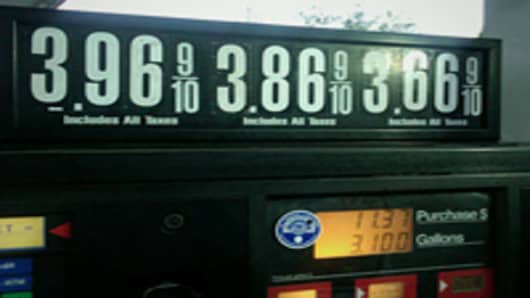
As U.S. consumers cope with gas prices that are approaching an average of $4 a gallon, some international trade experts say the cost of the sanctions the U.S. imposes — as in the case of the Iran measures — is something political leaders should discuss more openly. Instead, they say, most politicians act as if sanctions affect only the country targeted — something these experts say isn’t true.
“The approach is always that the costs are for them and the benefits are for us,” says Bill Reinsch, president of the National Foreign Trade Council (NFTC), a Washington lobbying organization that generally opposes economic sanctions. “The Iran case is interesting,” he adds, “because of the impact of sanctions on our energy sector.”
Energy experts say it’s difficult to pinpoint precisely how much sanctions on Iran are costing consumers as they filter down to the gas pump. But Lucian Pugliaresi, president of the Energy Policy Research Foundation, a Washington nonprofit organization that studies energy economics, says it’s possible to make an estimate.
The sanctions the U.S. and other countries have slapped on Iran’s energy sector and on its central bank (aimed at curtailing its oil exports) are costing Iran about 300,000 barrels a day in exports, Mr. Pugliaresi estimates. When added to other factors affecting the international oil market, that decrease in exports may have added about $10 to the current price of a barrel for crude, he says.
And that $10 increase translates roughly to about a 25-cent increase in the cost of a gallon of gas in the US, Pugliaresi says.
Of course the Iran sanctions — which President Obama has continued to ratchet up, including at the end of March when he decided to move forward with sanctions on Iran’s Central Bank he had signed into law in January — are designed to dissuade Iran from pursuing a nuclear program with a weapons capability, a goal many consumers may agree with.
But the NFTC’s Mr. Reinsch says consumers should be told what sanctions are going to cost.
“It’s a legitimate argument to say the benefits of the aim of these sanctions — convincing Iran not to build nuclear weapons – outweigh the economic costs,” he says. “What is not acceptable is to pretend there are no costs, or to ignore them.”
The Iran sanctions legislation that passed in January requires the president to consider the impact of moving forward on the central bank measures. Along with his decision in March to proceed with implementation, Mr. Obama issued a memo saying that after “carefully considering” factors including the state of the global economy, the availability of alternative oil supplies, and U.S. and other countries’ strategic reserves, he had determined that conditions existed to move forward.
Reinsch says his fire is aimed at the “hypocrisy” of members of Congress who press for ever-tougher sanctions on Iran’s oil sector, “but then turn around and complain about prices at the pump” as if there were no connection.
Another factor critics of sanctions raise is whether or not they are having the intended impact. Economists and regional experts generally agree that the sanctions on Iran are having an impact on the country’s economy. But less certain, critics say, is whether or not that will translate into the Iranian regime backing down on its nuclear ambitions.
In any case, Pugliaresi says consumers can take heart in the fact that the oil futures market seems to see the factors keeping crude oil prices up as temporary and moderating within a couple of years. Which means gas prices should be able to come back down — barring of course some other crisis in supply markets.

