

For 27-year-old Eneida Zaka, it was relatively easy to find work as an assistant accountant in her home town on the Greek island of Mykonos, as its popularity as a tourist resort had sheltered it from the crisis.
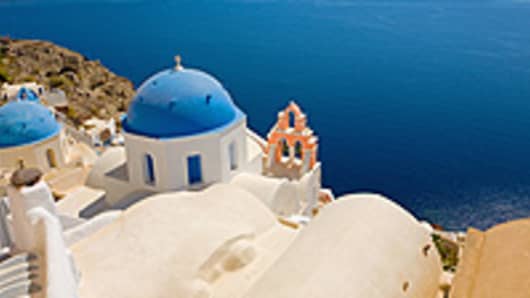
Tom Pfeiffer | Getty Images
View over the caldera of Santorini in Greece.
However, after three years she quit and began a further degree in auditing and accounting at the International University of Athens, which she hopes will help her gain employment abroad.
“I don’t like how accounting works in Greece. There is a lot of corruption, even in public organizations… Everywhere in the world there is corruption, but not like in Greece. The system makes you a little bit illegal,” she told CNBC.com.
Zaka explained that local businesses expected to receive warning of pending official audits, even though the inspections were supposed to be unannounced. If penalties had to be imposed, public officials might accept bribes in exchange for reducing them.
After graduation, Zaka hopes to work in England, Germany or France. “I believe the whole system works much better in these countries than in Greece,” she said.
Elections Loom for Greece
With snap elections around the corner after five months of technocratic government following last November's political turmoil, analysts worry migration will reach new peaks in 2012 — and that it is the brightest and best-educated who will leave, possibly for good.
Greek migration has escalated since the start of the nation’s debt woes, with unemploymentrates of near-22 percent, strict austerity measures, and political and social instability incentivizing citizens to head to European Union nations with sunnier economic climes.
Economic migration from peripheral European countriessuch as Greece to more prosperous ones pre-dates the crisis, and is facilitated by the legal entitlement of all E.U. citizens to migrate anywhere within the Union.
Low Value Added
But while manual laborers and those with few qualifications were always among those who headed abroad to work, Greece’s lack of value-added industries also made migration an appealing option for those with higher education.
“We are not producing high-value products, so private companies do not have need of big numbers of graduates," Lois Labrianidis, professor of economic geography at the University of Macedonia in Northern Greece and a specialist in Greek migration, said.
"That’s why these graduates are looking for better jobs abroad. The crisis has exacerbated a phenomenon which has been here for a long time.”
The number of Greeks registering their resumes with the European Job Mobility Portal — a European Commission-sponsored service designed to aid intra-EU job migration — reached 7,500 in 2011 alone, comparing with 8,000 new registrations in the years between 1993 (when the portal was created) and 2010.
Labrianidis’s own research suggests university-educated Greeks who work abroad or wish to do so are likely to be among Greece’s most highly qualified.
In a survey of 2,200 university-educated Greeks who were either currently working abroad or had previously done so for a year or more, Labrianidis found the majority (74 percent) held at least two degrees, while 51 percent also held a doctorate or PhD.
Greeks in London
Greeks looking to work elsewhere in the EU typically gravitate towards the UK and London in particular, mainly for language reasons. English is the first foreign language Greek children learn and is taught from the start of elementary school, usually for between two and four hours a week.

Image Source | Getty Images
“The other reason is that many Greeks go to the UK to study, either at undergraduate or postgraduate level, so they know the country quite well. Also, the salaries are quite high,” George Tzogopoulos, a research fellow at the Athens-based Hellenic Foundation for European & Foreign Policy (ELIAMEP), a not-for-profit think tank, said.
Twenty-four-year-old Anna Hondaj is one such student studying in the UK and she hopes to work in human resources in London on graduating. She started a Master’s degree in Management at London’s Birkbeck University after her search for graduate positions in Greece proved futile.
“I was unable to find anything at university graduate level. I applied for manager positions in Greece, but jobs were paid depending on how many clients you got — that made me think doing a Masters was a better idea,” said Hondaj, who originally graduated with a degree in European Studies from Panteion University in Athens.
“Positions are limited in Greece, you need to know people in order to get a job, and of course the salaries are below maintenance level,” she added.
Hondaj said studying abroad was common prior to the crisis, but was then viewed as a matter of individual choice rather than necessity. “Now it is more like everybody I know is doing it,” she said. Ex-course mates from Panteion University are studying for further degrees in the Netherlands and Belgium as well as the UK, and Hondaj is one of five Greek students on her course alone.
'Greece is Outdated'
Nineteen-year-old Ismini Petrides from Athens also chose to study for her undergraduate degree in the UK and is currently in the second year of a business administration course at Bath University in South-West England.
“I don’t really intend on moving back to work,” said Petrides. “Greece is outdated, there is lots of bureaucracy and it take ages to do things — public sector offices are open between 10 a.m. and 3 p.m. or sometimes just 9 a.m. to 10 a.m.”
She added: “Because of the line of work I have chosen — investment banking — I am limited to big cities. I could go to Dubai because I speak Arabic [Petrides’ family was previously based in Sudan], but I will probably start in London because of the good training.”
According to Labrianidis, Greek migrants tend to favor large international cities such as London, viewing them as culturally open, unprejudiced and able to offer high quality services.
Germany for Doctors
However, newly qualified medical doctors are increasingly looking to Germany, which suffers from shortages of medics in certain specializations. According to its Federal Statistical Office, German immigration rose by its fastest rate for 15 years in 2011, with 177,000 new immigrants arriving, many from peripheral European nations struck by high unemployment.
“Normally German hospitals do not have the full quota of doctors, so they open the door to other European citizens. There are many Greek doctors in Germany; they go for a two- or three-year temporary contract, and then gain a permanent one. It is like an internship, quite a good internship that is paid well,” said Tzogopoulos.
In the past, Greeks entering medical school could assume a job awaited them on graduation. However, Greece’s public sector hiring freeze means some newly qualified doctors are now forced to work without pay.
“They start working for free in Greece, but after they have worked for seven or eight months without getting a salary, they start looking at alternatives,” said Tzogopoulos.
Science Brain Drain
Greece’s broader science industry is hemorrhaging intellectual capital, according to Labrianidis. He calculates that between 114,000 and 139,000 scientists currently work abroad, or around 10 percent of the country’s base of science graduates.

Andy Sotirou | Photodisc | Getty Images
Labrianidis attributes this brain drain to a discrepancy in supply and demand for scientists within Greece, largely due to low demand for scientists from the private sector.
“This discrepancy cannot be perceived as a result of over-education in Greece, since Greece has not surpassed the optimal number of tertiary education graduates per capita… Concretely, Greek firms have not yet managed to occupy higher positions in the production value chains, in order to produce knowledge- and technology-intensive products and services,” he wrote in a report called ‘Investing in Leaving: The Greek Case of International Migration of Professionals’.
Aspiring academics who studied at private universities in Greece may find it easier to gain work abroad than at home, because the Greek government does not officially acknowledge their qualifications.
“Our private universities are not recognized by the Hellenic Republic, so graduates are not able to take jobs in public universities. They have to go before a committee, which will assess whether their qualification is suitable, and can be recognized. Bureaucracy is terrible for all Greek students,” said Tzogopoulos.
Those who studied abroad may also struggle to find work in Greece’s universities, as the government does not recognize any degree awarded outside of Greece, even those from other European Union countries.
Loss of Human Capital
Political and social analysts fear the long-term impact Greece may suffer from losing its brightest and best qualified citizens.
“I believe human capital is the most important factor in development. If a country loses it, this is a problem,” said Labrianidis. “The problem is even worse in Greece in that we are losing the most educated people, who are working abroad or are going to work abroad.”
“The politicians, the people who are making the legislation don’t really understand what it means to lose your human capital, to lose the most educated part of your human capital,” he added.
With the general election looming, Tzogopoulos is concerned the exodus will deprive Greece of new politicians who could spur its economy and politics out of the doldrums.
“It is very disappointing for Greek politics, because we need a change in the political personnel of the country. Instead the same people who led Greece into the crisis remain in the same positions in public administration. This worries me a lot,” he said.
“As things are now, the people who have left, they will not come back to Greece,” he added.
Those that do return are likely to be from more prosperous, “elite” families, according to Labrianidis. “These people’s parents have connections, or fortunes, or businesses, that can facilitate the return of their kids,” he said.
Rather than try to entice them home, Labrianidis said the government would do better in the short-term to encourage expats to work on behalf of Greece while remaining abroad.
“You don’t really expect these people to return, but on the other hand, there are quite a lot of them who are willing to work for Greece while they are abroad, or to come back for short periods,” he said.
“You can facilitate these things. For instance, you could sub-contract people for short periods back to the country. Or you could have a new appointment system whereby professors are able to hold joint positions between universities in different countries. Or you could have joint projects between countries,” he added.
Even with funding in place, Greek bureaucracy can still prove a bar to labor reforms or projects. For instance, Labrianidis said Greece had tapped an EU fund which finances graduate programs and apprenticeships in small firms. However, “There is too much bureaucracy within Greece for the businesses to access the funds,” he said.
In the meantime, commentators say the exodus of talented Greeks is likely to continue.
“It will definitely increase this year, because in 2012 we will experience the worst year yet of the crisis,” said Tzogopoulos.
