

Corn futuresare heading to record highs on reports of wider crop devastation, and as forecasts show continued hot, dry weather threatening even more of this year’s crop.
Getty Images
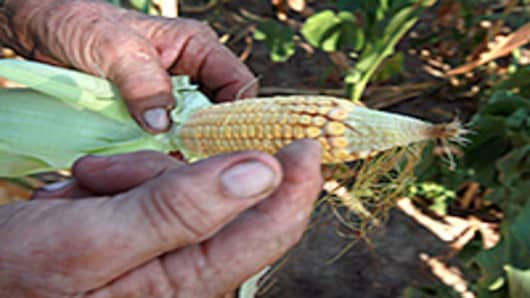
A farmer looks over an ear of corn picked from one of his fields near Ashley, Illinois. According to the Illinois Farm Bureau the state is experiencing the sixth driest year on record.
The latest U.S. Department of Agriculture data shows that just 31 percent of the corn crop is in good to excellent shape, a sharp drop from the 40 percent level last week.
Soybean conditions also declined to 34 percent from 40 percent last week, but the soybean crop, unlike corn, still has time to recover. (Track commodities here)
“We feel we should get back to $8. Our numbers with our sharply adjusted demand imply only $7.90 for December corn, but we do feel trade enthusiasm in the next couple of weeks will push it up above $8,” said Rich Nelson, director of research at Allendale.
The record high was $7.99 per bushel, reached last June.
December corn futures, representing the crop currently in the field, were trading slightly higher Wednesday at $7.73, after closing lower Tuesday on the possibility of rain for the eastern growing region.
Source: The Weather Channel
Nelson said demand destruction should start to come into play in the next couple of weeks, and that should keep a lid on prices.
“You’re not going to have everyone talking about it, but then suddenly it’s a whipsaw.”
The impact of rising prices is already being felt by the livestock industry, one of the biggest users of corn.
“We haven’t seen significant change yet in the breeding curve for any of the three main species, but all three industries are talking about smaller numbers,” said Nelson.
“As for pork, they’ll see their smaller production level next summer. In terms of cattle, it will be March/April in terms of shortfalls,” Nelson said. “And the chicken people might start dropping numbers in the next couple of months. By spring of next year, we should start seeing the result of this issue hitting the consumer.” (Watch:Protein Shortage Ahead?)
U.S. feeder cattle futures fell Tuesday to a more than nine month low as rising corn prices squeeze feedlots, resulting in the purchase of fewer younger animals. Hog futures also were lower.
Nelson said he has reduced his expectation for the corn crop to just 12.053 billion bushels, the lowest since 2006. He also expects the corn yield per acre is at around 137.2 billion bushels per acre currently, and that it could fall to 129.1 over the next couple of weeks. The USDA last week forecast the crop yield at 146 bushels per acre, down from its original forecast for a record 166 bushels.
Analysts expect to see livestock farmers reduce use of corn, as they slaughter animals or reduce the amount of feed.
“What you end up seeing a lot of time is the magic of someone trying to make every bushel of corn stretch. You see slightly reduced feeding rates. They will feed cattle a little less every day. It will take them longer to get up to slaughter weight,” said Randy Mittelstaedt, director of research with R.J. O’Brien.
"If the crop is as low as I think it will be, we’re going to have to see a reduction in animal numbers,” he said.
Mittelstaedt expects to see a crop yield of 135 bushels per acre, the lowest in 10 years. He expects a total crop of 11.4 billion bushels.
“In terms of outright production, it’s the lowest in the last five years. When you look at total supplies, which is what is available for the entire year, it’s the lowest supply since 2003, 2004,” he said.
While meat prices will rise, cereals and other corn-based food products are unlikely to show as dramatic a jump.
Nelson said corn amounts to only about 12 cents for each box of cereal. “A 40 percent rise in the grain price is actually only about a 2 percent rise in the product,” he said.

Getty Images
Food is a relatively small share of the corn crop, with the bulk going to grain feed and ethanol. The USDA projects livestock use of corn will be 4.8 billion bushels in the year beginning September 1, and ethanol production is expected to be 4.9 billion bushels.
Exports are expected at 1.6 billion bushels. The government expects a total crop of 12.97 billion bushels, down from its earlier forecast for an all-time high of 14.8 billion bushels but well above industry forecasts.
“We’re really going to see this ethanol story heat up and that’s probably going to be sooner than later. That’s going to be interesting how this thing plays out. Nobody’s going to make any major moves on the required ethanol use until they know what the crop size is,” said Mittelstaedt. Ethanol producers have been shutting down some production, as driving demand ebbed and margins were pinched.
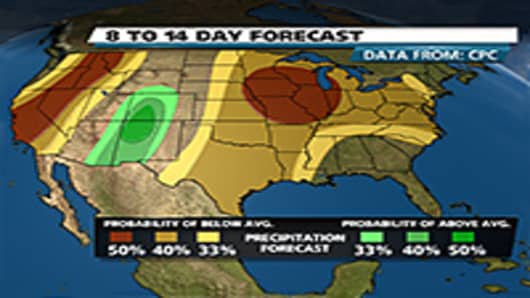
The hot, dry weather is expected to continue in the Midwest and is now spreading to the western and northwestern partsof the corn belt. The scorching heat has come at the worst possible time for corn. During the worst of the hot weather, much of the corn belt was in the “tasseling” stage , which is when corn pollinates and the size and quality of kernels are determined.
Mild, wet conditions earlier this spring resulted in farmers planting the corn crop much earlier than normal. As a result, 71 percent of the crop has pollinated or is pollination, compared to a five-year average of 36 percent, according to USDA. Only 16 percent of the soybean crop was in the critical “pod-setting” stage.
The current rain forecast is for one inch or more in each of the next two weeks, but it is unlikely to make much of a difference.
“I don’t think it changes much in terms of the crop size moving forward,” said Mittelstaedt. “The damage is done. The majority of the yield loss has already been assured.”
Crops trading on weather are highly volatile and very emotional, he said. “What you can’t say is what about the impact on the market. If it started raining tomorrow, and it rained for two weeks, corn would break $2 ” despite the damage, he said.
Follow Patti Domm on Twitter: @pattidomm
Questions? Comments? Email us at marketinsider@cnbc.com
