

If you could own a piece of the New York Yankees, would you overpay for the privilege? Dallas Cowboys? L.A. Lakers?
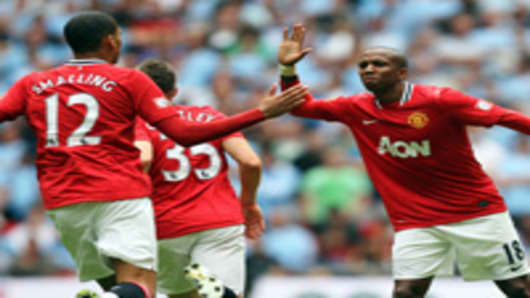
Ian Walton | Getty Images
Manchester United IPO
If you're a fan of the team, you probably would.
Across the world, soccer's Manchester United boasts more fans than any of the aforementioned American teams — the team estimates a base of supporters well over 600 million. And in less than a month, just about any of them will be able to make a call or click a mouse and own shares of the iconic team, winners 19 English Premier League titles.
Buying shares, to many, will be a good idea for various reasons, but the true issue is whether they are buying a good investment.
Let's start with why a famous British soccer (er, football) team is going to list and trade at the New York Stock Exchange.
Put simply, Malcom Glazer, who bought the team in 2005 for $1.2 billion, wants to go public, raise funds and mitigate risks, yet still retain absolute control of the team.
By listing in New York, the Glazer family will create a dual-class share structure, allowing them to keep voting rights. It's a model similar to how the Murdoch family retains control of News Corp . The London Stock Exchange does not allow this. Initially, the listing was slated for Singapore — which also allows a dual-class structure — but last fall, market conditions were too volatile, and it was moved to the United States.
That, in and of itself, is not a reason to be pessimistic about a franchise that turns a profit every year and actually has a track record of being a solid equity investment. Manchester United averaged better than 20-percent annual appreciation in the 14 years it traded prior to the Glazer family taking it private seven years ago.
A lopsided stock-ownership dynamic does not sound the investment alarms the way the franchise's debt does. For perspective, in 2005, the team carried no debt. in 2012, it's about $650 million. Basically, the Glazers leveraged quite a bit to get the team, and have used it as a piggy bank of sorts since the acquisition.
If the IPO raises the expected $300 million, the assumption is that much of that will pay down debt. Fans hope some is left to buy decent players in order to keep up with the competition, which has become more intense since Manchester United lost the league title to cross-town rival Manchester City, which is owned by a group from Abu Dhabi. In recent years, pressure to service Manchester United's debt has sucked hundreds of millions out of team coffers that could have been used to improve the product on the field (er, pitch).
Another issue surrounding the IPO is accountability. Because of a loophole for foreign companies, which is buried in the Jobs Act, Manchester United will not have to report results every quarter. The franchise also does not have to give forward-looking guidance.
Pretty sweet deal ... for ownership. But what about investors?
Who wants shares in a company saddled with debt where shareholders — even big ones — have no control?
Some will buy for the same reason people bought shares in the Green Bay Packers, a stock that is such a novelty that shares have no dividend and cannot be sold for a profit. There will be appetite from wealthy fans who love the team and want that cocktail party power of claiming ownership of the famed Red Devils.
But that doesn't mean they'll make any many off of it.
So, it could be a tough sell — especially to institutional investors — and there is very little in the way of comparison because it is a rarity to get the chance to exclusively trade a professional team. In the U.S., you can buy MSG — you get the NBA's New York Knicks. But you also get the NHL Rangers, a WNBA team, an arena and a TV network. Sorry, no Jeremy Lin.
With a company like Liberty Media , the Atlanta Braves baseball team is just one component in a huge portfolio of companies. Also in baseball, Nintendo owns most of the Seattle Mariners, while Rogers Communications has a small piece of the Toronto Blue Jays.
All of these are indirect ways to own a sports team.
In terms of direct ownership, outside the U.S., there are a handful of soccer teams that actively trade. For example, AJAX trades in the Netherlands; Juventus in Italy; Benfica in Portugal. Fenerbache is a lesser-known name. It is listed in Turkey, but has an annualized return of almost 14 percent.
The other aforementioned teams all have had NEGATIVE annualized returns.
Those are losing investments, and it is yet to be determined which category will fit Manchester United. What we do know is that warm ups are beginning — the road show begins in Europe. It is being marketed as a global roadshow before ending in the U.S. for game time: Pricing and trading is expected at some point in August.
That is just in time for the real season as Manchester United opens the season on August 20th with an away match against Everton.
We shall see which is the bigger winner, the team on the pitch or the stock with the global sales pitch.
-By CNBC's Brian A. Shactman
@bshactman