Go Symbol Lookup
Loading...

Home Depot Earnings Top Estimates, Boosted by Housing Recovery

Corn Prices Jump as Crop Size Shrinks

 Text Size  
Published: Tuesday, 31 Jul 2012 | 10:36 AM ET
Patti Domm By:

CNBC Executive News Editor

Getty Images
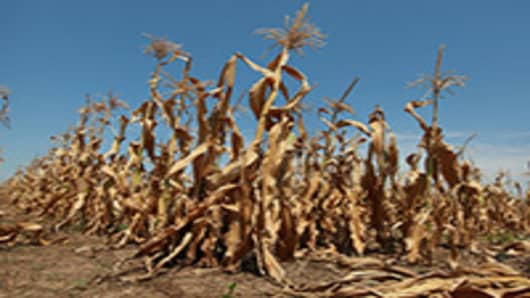
Corn plants struggle to survive in a drought-stricken farm field near Oakton, Indiana.

The U.S. corn crop continues to shrink, and that is likely to continue driving corn prices to new highs.

The latest U.S. Department of Agriculture data, released Monday afternoon, showed that now just 24 percent of the corn crop in 18 key states is in good to excellent condition, and 48 percent is now in poor or worse shape as the drought and heat persists in the corn belt.

That is more bad news for livestock producers, who have been hurt by the rapid rise in corn prices, up more than 28 percent in July and about 50 percent since early June.

On Monday, livestock and poultry producers asked the government to reduce or cancel the use of corn-based ethanol in gasoline for a year. The USDA expects ethanol use about 40 percent of the corn crop, and livestock about the same, though farmers have been culling their herds because of the high cost of feed.

December corn futures Monday ended at a record $8.14 per bushel, and rose to $8.20 per bushel in early electronic trading Tuesday, before moving lower on profit-taking.

Soybeans were also reported to be in worse shape, with just 29 percent of the crop estimated to be in good to excellent shape, down from 31 percent last week, according to USDA data. But for soybeans, there is time for the crop to improve if there is rain. Analysts say the USDA weekly conditions report is a rough measure of the crop, and it is now difficult to tell without field trips how much the corn is deteriorating. The USDA does field visits in August.

“You keep getting these hit or miss little light showers and it does nothing,” said Randy Mittelstaedt, director of research at RJ O’Brien. “We’ve seen some really, really good rains across northern areas. Minnesota had quite a bit of rain, Ohio had rain, but the heart of the corn belt continues to suffer.”

The yield on this year’s corn crop is expected to be the worst in 10 years. The yield was 129.3 bushels per acre in 2002.

“Most people’s thinking now is 130 to 132 bushels per acre. I think there’s a sub-130 possibility. I wouldn’t be surprised if we go below that 2002 level,” Mittelstaedt said.

Currently, the USDA expects yield of 146 bushels per acre, subject to revision Aug. 10 when its world supply and demand report is released.

Follow Patti Domm on Twitter: @pattidomm

Questions? Comments? Email us at marketinsider@cnbc.com

 Print
The U.S. corn crop continues to shrink, and that is likely to add upward pressure to prices, which hit a record Monday.

   
Comments


More Comments


Add Comments


Your Comments (Up to 1100 characters):

Remaining characters

Your comments have not been posted yet.

Please review your submission to make sure you are comfortable with your entry.

Your Comments:


Featured

  • Patti Domm is CNBC Executive Editor, News, responsible for news coverage of the markets and economy.

  • Greenberg is senior stocks commentator for CNBC appearing throughout business day programming and on CNBC.com.

  • A CNBC reporter since 1990, Pisani reports on Wall Street and the stock market from the floor of the New York Stock Exchange. Follow him on Twitter @BobPisani.

  • Epperson covers the global energy, metals and commodities markets from the NY Mercantile Exchange for CNBC and CNBC.com.

  • Santelli joined CNBC Business News as an on-air editor in 1999, reporting live from the floor of the Chicago Board of Trade.

  • Senior Editor at CNBC, commodity trader in a former life.

  • CNBC Markets Producer

  • Senior Producer at CNBC's Breaking News Desk.

  • Website Producer at CNBC