Go Symbol Lookup
Loading...

Stocks Fall After Fed Minutes Show Willingness to Taper in June

Bill Gates and the Caltech Solar-Powered Toilet

 Text Size  
Published: Friday, 17 Aug 2012 | 10:59 AM ET
By: James Burgess|for Oilprice.com

According to Bill Gates, nearly 2.6 billion people, 40 percent of the world's population, do not have access to clean sanitation. This results in the deaths of approximately 1.5 million children under five every year.

The problem is that the modern toilet, whose design and technology has not changed much since its conception in 1775, requires a lot of water and energy, both of which are in short supply in much of the developing world.

Source: California Institute of Technology | Youtube
Solar powered toilet

In order to tackle this problem the Bill and Melinda Gates Foundation has invested about $6.5 million into projects developed by various universities and organizations that are trying to ‘reinvent the toilet.’ In total the foundation spends about $80 million a year on water, sanitation, and hygiene issues.

(More: What Has Been Driving Global Oil Prices Recently?)

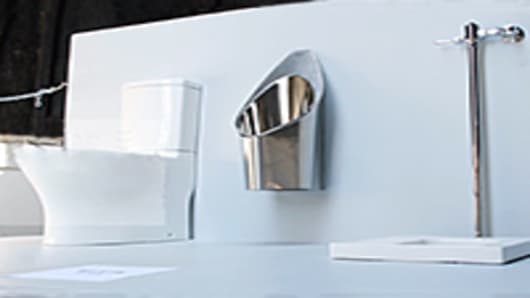
$100,000 has just been handed to the California Institute of Technology for its research into a self-contained, solar-powered lavatory system which recycles water and breaks down the waste into storable energy.

(More: Kazakhstan to Solidify Caspian Energy Role)

Caltech’s design uses energy from the sun to break down the waste into hydrogen gas, which is then stored in hydrogen fuel cells so that the unit can continue to operate during the night, or during times of low sunlight. The water used for flushing is cleaned and recycled to be used again for subsequent flushes.

By James Burgess of Oilprice.com

—This story originally appeared on Oilprice.com. Click here to read the original story.

 Print
According to Bill Gates,  nearly 2.6 billion people, 40 percent of the world's population, do not have access to clean sanitation. This results in the deaths of approximately 1.5 million children under five every year. The problem is that the modern toilet, whose design and technology has not changed much since its conception in 1775, requires a lot of water and energy, both of which are in short supply in much of the developing world.

   
Comments


More Comments


Add Comments


Your Comments (Up to 1100 characters):

Remaining characters

Your comments have not been posted yet.

Please review your submission to make sure you are comfortable with your entry.

Your Comments:


Featured