

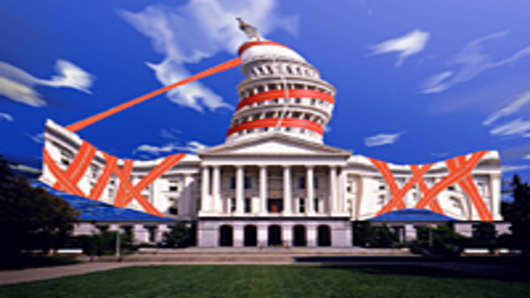
The sluggish U.S. economy has been relatively kind to Wall Street's banks, many of which are flush with profits and stand to gain from the Federal Reserve's new bond-buying effort.
Yet these same financial titans are warning that the government's inaction in the face of the approaching "fiscal cliff" poses real risks to an economy already saddled by stunted growth and a burgeoning debt load.
Many Wall Street banks hold interest-rate sensitive products on their books, and stand to lose big if a debt crisis sends safe-haven Treasury yields spiking.
Thus far, investors have been most preoccupied by the unfolding financial catastrophe in Europe, where debate rages about whether Spain will finally throw in the towel and accept an international bailout.
Still, the threat of higher taxes and deep spending cuts loom large. The noise of the presidential election and partisan gridlock in Washington has left budget negotiations at a standstill.
Carlyle Group co-founder David Rubenstein said Friday that a short-term "grand bargain" that prevents the U.S. economy from going over the fiscal cliff was unlikely in the lame-duck session of Congress – which runs between Election Day and January 2013. Still, he thinks the next president must come to terms with the burgeoning deficit. (Read more: Investment Can Thrive, but Fiscal Fix Needed: Rubenstein .)
"The most important thing the next president has to do is resolve the uncertainty of the debt and deficit, " Rubenstein said, adding that it was impossible to predict whether either President Barack Obama or Republican nominee Mitt Romney would be better for the economy.
At this point, few observers are holding out much hope for an immediate fix to the problem. Yet as the deadline looms, market observers increasingly despair that policymakers – much like the cinematic semi classic "Thelma and Louise" – may drive right over the precipice with hands locked in defiant unison.
In a CNBC interview this week, the authors of the Simpson-Bowles chided Congress and the White House for doing virtually nothing as the country comes closer to a January 1 deadline that will see tax rates spike and spending slashed drastically. (Read more: US Nears Fiscal Disaster: 'Washington Doing Nothing' .)
Goldman Sachs CEO Lloyd Blankfein said that fixing the fiscal morass was integral to keeping capital flowing, which could help jumpstart a jobs market that remains stalled at best.
"We have to get our budget on a sustainable path where it's predictable, " Blankfein said. "What we really need to do is fix the US economy on a sustainable basis so three's some predictability, so people don't stand on the sidelines and so they go and invest and jobs get created."
J.P. Morgan CEO Jamie Dimon said earlier this week that policymakers missed an opportunity by overlooking a tax and spending blueprint made by the Simpson-Bowles Commission. Had their recommendations been adopted, Dimon said the economy would have been "booming."
The resulting fight between Congressional Republicans and the White House over spending resulted in Standard & Poor's meting out the U.S.'s first ever credit downgrade last year.
Some say the U.S. is being lulled into a false sense of security by borrowing costs that remain near historical lows. As investors lay siege to the government bonds of the euro zone's most distressed countries, Treasuries have yet to see the same selling pressure.
Dimon, however, thinks that calm might not last if the U.S. doesn't get serious about policing the deficit.
A sell off in Treasuries is "virtually assured, the question is when and how, " the Wall Street chief said, adding that it could take anywhere between two and five years before the market's patience runs out.
"The united States can't borrow indefinitely, " Dimon said. "We are going to have fiscal discipline if it is imposed upon us, or we do it to ourselves in the right way."