

Gasoline futures jumped as cranky consumers on the East Coast—already stressed by the wrath of Superstorm Sandy—joined long lines at the pump to fill up their cars and gas cans to fuel home generators, causing shortages in some areas.
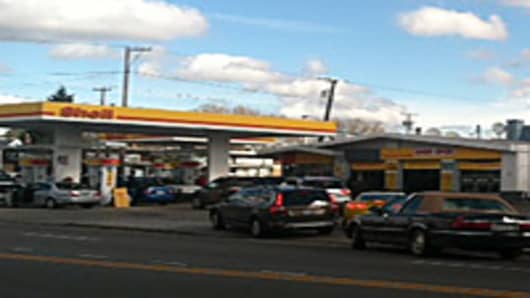
Photo by Patti Domm for CNBC
Though retail gasoline prices were steady or dropping at the pump through Tuesday, they could start to spike in hard-hit areas of the storm, particularly the New York metropolitan region.
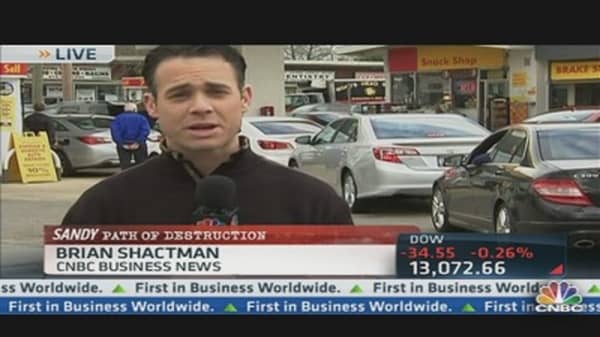
Shortages were already affecting all types of stations. In New Hyde Park on Long Island, N.Y., CNBC found several stations already out of fuel, while two others in the center of town were dealing with huge lines and thin patience.
As more drivers emerged from storm damaged residential areas, lengthy lines with hours long waits formed around the region at gas stations that still had fuel and power.
"The price spike will last several days, probably as long as a week, and then it will depend on whether or not some of the key facilities get back on line, like the ports and the Colonial Pipeline," said John Kilduff of Again Capital. "The ports are open but there are severe restrictions on navigation."
(Read More: Scenes From Hurricane Sandy.)
Shell, which has many services in the storm hit zones, advised consumers to conserve fuel and avoid unnecessary driving while Shell-branded stations are being reopened and restocked. BP said one third of its branded gasoline stations in the New York, New Jersey area were shut due to flooding, lack of power, or no fuel.
"You have a lot of stations that are closed, and they're closed due to no power or no product or both," said Kevin Beyer, president of the Long Island Gasoline Retailers Association. He said less than half the more than 600 gas stations his organization represents between Brooklyn and Montauk, N.Y. have both gasoline and power.
But the stations with power are running short of supply, and he does not foresee many deliveries before Friday or in the region because of flooding and damage to terminals in Inwood, Holtsville, and Lawrence. CNBC watched a delivery Wednesday afternoon to a Shell station in New Hyde Park from a tanker truck filled at the Holtsville terminal.
"There's a lot of disruption right now," Beyer said. "It's the terminals themselves. You have terminals that are running very low. Terminals that might be out. The power's been sporadic and there's no phone service," making it hard to check on the status. He said there are some trucks running but not many.
"Right now, we are working with our independent distributors in order to help meet consumer demand for fuel. Provisions have been made to ensure that emergency responders and other essential service providers requesting fuel are given priority," according to an ExxonMobil spokeswoman.
In the futures market, front month November RBOB gasoline jumped as much as 7 percent before retreating while traders covered shorts. The more actively traded December contract jumped more than a percent to about $2.64 per gallon.
Meanwhile, AAA reported the national average for gas at the pump at $3.52, down from $3.53 per gallon Tuesday. The price of gasoline in New Jersey was an average $3.553, up slightly from $3.551 Tuesday, but below last week's average $3.62. New York gasoline averaged $3.92, down from Tuesday's $3.93 and down from last week's $3.99 per gallon.
"The quick and dirty is that in the Northeast, about 24 percent of the refining capacity that was in the line of the storm is out," said Addison Armstrong of Tradition Energy. "That's really just two refineries, the Bayway refinery in New Jersey and another smaller refinery there," said Addison Armstrong of Tradition Energy.
Armstrong said there could be a sharp jump at the pump, but some gasoline experts believe the spike will be short-lived because of adequate gasoline supplies nationwide.
(Read More: Sandy's Economic Cost: Up to $50 Billion and Counting.)
"The situation is that we've got production capacity down a little bit but we've also got demand down quite a bit because a lot of people aren't on the road, " Armstrong added. "The real problem today however is that we've got the expiration of the November gasoline contract which requires delivery or can require delivery in the New York harbor and New York harbor is closed. Add to that the fact the colonial pipeline, which brings gasoline supplies from refineries in the Gulf Coast up into the Northeast is having a lot of difficulties particularly in Linden, New Jersey, where it has had to bring in emergency backup generation to keep the pumps running."
Andrew Lipow of Lipow Oil Associates said while the gas price might jump in the New York region temporarily, he still expects to see a lower national average in the next couple of weeks. "I can't speak about what the individual gas stations are going to do there, but when I look at wholesale prices off of the December contract, there might be some higher prices in New York temporarily but retail prices in the rest of the country are falling," he said.
Lipow said the New York area airports appear to have sufficient jet fuel.
The two east coast refineries that remained closed, include Phillip 66's big Bayway refinery in Linden, N.J., and the Hess refinery in Port Reading. East coast refineries, including four in the Delaware and Philadelphia area, account for about 6.5 percent of U.S. refining capacity. Besides the refineries, gasoline terminals in northern New Jersey remained closed due to power outages and flooding.
Shell said its Motiva terminals, which it jointly owns with Saudi Aramco, are still being assessed. Its terminals in New Jersey and New York have experienced flooding due to the storm surge, as well as power and wind damage, the company said. An unknown amount of diesel leaked from two storage tanks in Sewaren, N.J. but the leaking has stopped, Shell said. The company is skimming released product with booms in the Woodbridge creek.
Shell said it reopened its Baltimore, Md. with reduced operations and two Virginia terminals are reopened and fully operational. In Connecticut, it is working to restore power at New Haven and Bridgeport. But the New York area facilities at Sewaren, Newark, N.J. and Brooklyn and Long Island, New York have no restart date yet.
BP said its Carteret, N.J. terminal experienced flooding. Personnel are on the scene working to resume operations. Its Port Newark terminal is currently being accessed for damages so crews will formulate plans to reopen the terminal.
Nustar which also has a terminal in the Linden area said it suffered high water damage to the marine and storage terminal but its truck rack terminal appears undamaged though it's without power.
The Colonial Pipeline said it is in the process of hooking up generators to restore operations, while waiting for power to be restored. The pipeline company said the Department of Homeland Security said restoring power to the pipeline is a top priority and it hopes to be open by Friday. Colonial said assessments provided by terminals served from its Linden facility indicate severe flooding, power losses and other damage, but its operations in southern New Jersey, Maryland and Virginia are recovering more quickly.
The Buckeye pipeline was in the process of restarting its system. Lipow said its pipeline from Philadelphia, to Pittsburgh and upstate New York is being restarted, and service on its pipeline that goes from New Haven to Massachusetts is also being restored.
Follow Patti Domm on Twitter: @pattidomm
Questions? Comments? Email us at marketinsider@cnbc.com


