

Online retail king Amazon is ramping up for Black Friday, with sales leading up to their "week of Black Friday sales" (which lead up to the big day itself).
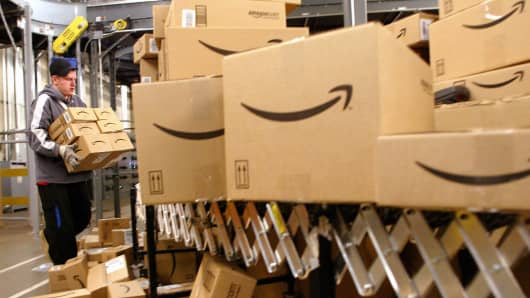
Ken James | Bloomberg | Getty Images
Daniel Brendoff sorts boxes before loading them onto trucks for shipping at Amazon.com's fulfillment Center in Fernley, Nevada.
Overkill? Maybe. But Amazon's versatility as an online merchant makes it easy for the retailer to trot out Black Friday prices whenever it wants—a luxury that has allowed it to increasingly dominate the holiday shopping market over the years.
And that dominance is likely to continue. Shoppers spent $37 billion online last year, spiking 15 percent from 2010, according to comscore.com.
But Amazon's renowned ability to offer the lowest prices faces a new wrinkle: new sales tax rules regulating online merchants. Right now, Amazon has to collect sales tax in eight states, including large markets like New York and California. Will this affect the company's ability to match prices and compete with Walmart, Target, and Toys R Us?
Not really. "Amazon is just passing the sales tax on to the consumer, it's not like they're eating that 5-10 percent," Michael Brim, founder and CEO of the Black Friday deals watch site BFAds.net, writes via e-mail. "This won't affect their ability to price-match."
What's more, he adds, most Amazon customers have always had to pay a "use tax," which is levied in most states on material purchases that are otherwise tax-free. Switching that out with a sales tax won't change much. Couple that with Amazon's super competitive shipping rates (orders above $25 are free, and Amazon Prime subscribers get free shipping on all orders) and the online giant remains tough to beat during the holidays.
Those free shipping perks will be available to a wider range of customers this year. Amazon Prime has always been an annual service, with subscribers paying $79 per year for free two-day shipping. Now Amazon is offering monthly Prime subscriptions for $7.99. So shoppers who do all of their online shopping during the holidays, and very little during the rest of the year, can pick and choose the months they want to subscribe a la carte (for slightly more per month than the annual rate).
And as far as the big deals go, Amazon is already getting competitive, according to Mr. Brim. BFAds has an extensive list of televisions and home theater products that Amazon has plans to discount "sometime in the very near future or through the holidays." The list already includes items that match the prices offered at Best Buy, Sears, and Kmart.
"Online is Amazon's bread and butter. It's their playground, and currently, they're calling all the shots," he says.
He's less impressed with those pre-Black Friday deals, at Amazon and elsewhere: "These pre-Black Friday sales, on the whole, do not compete with the Black Friday sale. But there are individual items that are Black Friday caliber. [Last week] Amazon put its Kindle Firetablet/eReader on sale for $129, $30 below retail. That was a very good deal, one we might not see again until Black Friday."
So Amazon's prices will be competitive, and collecting sales tax won't change that. But consumers in certain states will still have to tack the levy onto Amazon's low advertised prices. Below are the sales tax rates for the eight states in which Amazon collects:
- California: 7.25 percent
- Kansas: 6.3 percent
- Kentucky: 6 percent (except groceries)
- New York: 7 percent
- North Dakota: 5 percent
- Pennsylvania: 6 percent
- Texas: 6.25 percent
- Washington: 6.5 percent