

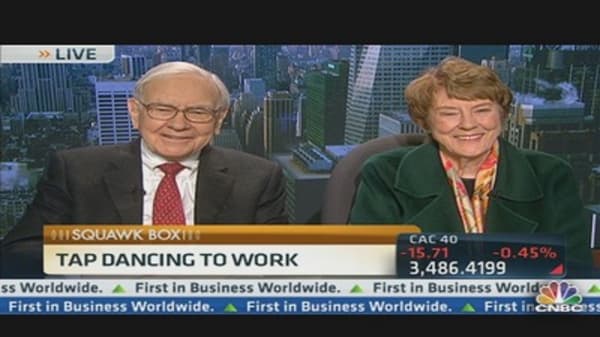
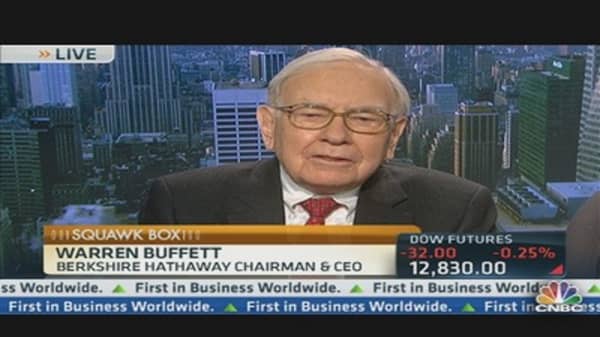
Warren Buffett and his long-time friend Carol Loomis, an editor at Fortune, appeared live on CNBC's "Squawk Box" to promote a book that collects the magazine's past articles about the Omaha billionaire.
During the interview, Buffett said he expects Congress to reach a "fiscal cliff" deal but thinks it could happen after the December 31 deadline.
This is a transcript of the entire appearance on Wednesday, November 28, 2012 at 8a ET.
JOE KERNEN: We have a big line-up this morning. Warren Buffett — last time I saw Warren, he had an ugly tie on, and he sent it to me. He brought—right?
ANDREW ROSS ANDREW: It's true.
(Read More: Buffett Expects 'Fiscal Cliff' Fix, but Not by December 31)
JOE: You brought it back—I have it up at my desk. It's an ugly tie. He sent me a brick so far, which is pretty ugly, and a tie. That's it.
BECKY QUICK: Have you thanked him for either of those gifts?
JOE: When I get the NetJet card, I will—I will thank him appro—I will. Thanks, Warren, for the brick. Warren Buffett's going to join us with biographer Carol Loomis in just a minute. Thanks for coming on. We have plenty to talk about with the Oracle of Omaha.
***
ANDREW: Everything down. Not a great way to start the morning, but a great way to start the morning since we do have Warren Buffett on the show.
BECKY: That's right. And red arrows. You know that Warren Buffett likes to buy when he sees red arrows, so.
ANDREW: That is true. That is true.
BECKY: Warren Buffett, obviously, is a familiar face here on "Squawk Box". He is the subject of a new business biography. He joins us this morning along with Carol Loomis, who is senior editor-at-large at Fortune magazine. Carol's the author of the new book on Mr. Buffett, "Tap Dancing to Work: Warren Buffett on Practically Everything, 1966-2012." And Warren and Carol, thank you both for joining us this morning.
WARREN BUFFETT (Berkshire Hathaway Chairman and CEO): Thanks for having us.
CAROL LOOMIS (Fortune Magazine Senior Editor-At-Large): Great to be here.
BECKY: You know, Carol, you've known Warren Buffett for over 45 years. You have a long friendship and you're somebody who knows probably his take on business better than anybody out in the world. People have been waiting for a book like this...
LOOMIS: Great.
BECKY: ...but you talk to him every day and in putting this book together, is there anything that you learned or anything that you were able to say, you know, 'This is something I hadn't thought about in a while'?
LOOMIS: Well, first of all, I just learned all over again how good he is. You just see it all through the book. He's—the brilliance and the new ideas that keep coming up. But I think the thing I was most struck by was how consistent his thinking has been as he has gone through these years. In the early part of the book when he is advising Grinnell College about its—how to invest its investments—how to invest its endowment fund, he is staying off to the side while Grinnell decides to invest not—to invest in Intel. Bob Noyce went to Grinnell. And so Grinnell is making an investment in Intel, but Warren is just standing off to the side saying, 'I don't understand semiconductors, so I think you should just go ahead and do whatever you do, but I'm not—I'm not getting into this one way or the other.' And that—and then he's exactly the same when he gets to the bubble. And if we had another bubble, he'd be exactly the same again.
BECKY: Wow. You know, Carol, when you first met him back in 1967, what was your first impression? Did it jump out at the time that he was a great investor?
LOOMIS: Well, my husband had already told me who had met him earlier that he thought he was—he had met the greatest investor in the country. And, you know, I probably was a might skeptical about that at that point. And then I met him with (Buffett's first wife) Susie. We all had lunch in New York. And I realized that Warren was unlike anybody I'd ever met—more impressive than anybody I'd ever met, knew more details about things that I was interested in. And I thought, `No, this guy is really different,' and I must say we bought the stock. So—and he was—he was really virtually unknown at that point.
JOE: Grinnell—who would've thought Grinnell College would be in the news? Did you write a letter to that guy, Warren, or did you give him a dollar a point or $10 a point for those 138 points ? Did you see that? That kid? That was Grinnell.
BUFFETT: What?
LOOMIS: Oh, the one that had the basketball.
BUFFETT: The basketball player, yep.
JOE: One hundred and thirty—yeah.
LOOMIS: The big basketball—oh, sure.
JOE: This is the first time we have said Grinnell College twice in the last week and that has got to be—I don't think that has ever...
BECKY: Happened on "Squawk" before?
JOE: Yeah. I would have never imagined that. It's amazing.
BECKY: Yeah.
BUFFETT: I think he got 70. He had a high percentage of three-pointers, too, I'm right.
LOOMIS: Yeah.
JOE: He did. Twenty-one out of 27, but taking 27 three-pointers...
BECKY: Three point shots. Right.
JOE: ...in one game is amazing. Warren, is that—that looks like the tie you sent me. Did you have more than one or something?
BUFFETT: Joe, I have—I have lots of ties to send you, although the sort of plugs they get after I send them to you, I'm not sure I'll keep doing this.
JOE: So that's what I see, bricks and—bricks and ties you don't really like...basically.
BUFFETT: What would—what would you like? Dilly Bars? We've got those. I mean, you name it.
BECKY: Andy.
JOE: See, he's asking like he doesn't know what I really want. You know...
LOOMIS: My experience over the years, having known Warren this long, is he gets a favorite tie, he sticks with it for quite a long time.
JOE: It works for him.
LOOMIS: It works for him. So he really doesn't change.
JOE: Carol, I just heard some stuff. Have you—have you ever played—do you play golf with Warren, Carol?
LOOMIS: I have played golf with Warren.
JOE: Did you bring him to Winged Foot? Has he been—that course would kill either the east or the west would kill him.
LOOMIS: Well, I don't think that we have tried out Winged Foot. We have mainly played in Maine at a course called Prouts Neck.
BUFFETT: Yeah. We played on my 50th birthday, though, remember? We had the semi-centennial tournament at Winged Foot.
LOOMIS: Oh, that's right.
BUFFETT: Yeah, George.
LOOMIS: Oh, I did forget—I did forget about that. So and also in Omaha, I've started to play a little bit with him.
JOE: All right.
BECKY: Warren, when you first met Carol, what was your first impression?
BUFFETT: My first impression was that she was pregnant.
LOOMIS: It does stick with you.
JOE: Was she?
ANDREW: I hope she was, right? I mean, that's...
BUFFETT: I had a—I already had an impression. I knew she was a terrific writer. I'd been reading her stuff, and, you know, she was the first—the first woman to become a writer for Fortune, and they made a terrific choice. And ever since then, I mean, she's been the number one read for me in the financial world.
ANDREW: So, Warren, Carol helps edit your annual report or your annual letter to investors . When did that start and what inspired you to do it?
BUFFETT: Well, in 1977, I gave her a copy of the draft and asked her if she would edit it. She's a terrific editor. And I'd been on a committee at the SEC on disclosure, and I really decided that year I was going to step up the communication with shareholders, and so I thought I'd let her take a look at it. And she made very few changes the first year, but she's sort of gotten in the swing of it since.
LOOMIS: It's not—I wouldn't say it's accelerated every year, but there are a few more comments, a few more suggestions.
BUFFETT: She's very diplomatic. When she doesn't like something, she says, 'This is my least favorite part of the report,' which means it's a bunch of junk.
BECKY: Why don't we talk about some of the issues that are in the news today. And, Warren, you've made newsthis week with your op-ed piece that you had earlier this week in The New York Times about taxes. A lot of people have talked about what you've laid out, the "Buffett Rule," and what you'd like to see. One thing that we may not have talked about a lot, though, is in that, you laid out where you thought higher taxes should be raised on people. You thought the starting point should be at 500,000 instead of the 250,000 that the president has proposed. I know you spoke with the president last week, he put out a news release about that. Did you tell him at that point that you thought the starting number was too low?
BUFFETT: Yeah. He—well, he knew my view on it because I had sent—they made a call on Friday and said would I be available for a call on Saturday from the president. I've never called him, but—and since I knew I was going to put out this op-ed piece, I sent him a copy prior to the phone call on Saturday, of the piece. So he had seen the $500,000 figure when we talked. He did not specifically bring it up.
BECKY: Did you bring it up to him?
BUFFETT: No, he'd seen it. I mean, I knew it was there in front of him. Since he—since he was saying 250, I did not think it was a great subject to bring up.
BECKY: Did he make any comments about your op-ed piece?
BUFFETT: Well, he certainly didn't argue with any of it. I mean, he just briefly said that he's seen it. He said something to the effect that he liked it. But we didn't get into a detailed discussion of it.
BECKY: You know, you two have seen a lot of things that have happened in business and seen a lot of things that have happened around the country, and we have been trying here to try and find some sort of fit—fix to the fiscal cliff and the fiscal abyss. I know, Warren, in the past you've told us if you sat down, you could figure out in a matter of minutes some sort of solution that probably both sides could live with. Warren and Carol, if you could put up some sort of a plan, having seen what's happened with politics in Washington, what would that plan look like?
BUFFETT: Well...
LOOMIS: I'll defer to Warren.
BUFFETT: Well, the plan would have—would get us in the near future to having 18 1/2 percent of GDP as revenues and 21 percent of GDP as expenses. We've had that plan basically in effect since World War II. I mean, it's bounced around a little bit, but that—those two levels, 18 1/2 and 21 are sustainable in the sense that they will not increase the ratio of the national debt to GDP. They'll run a deficit every year, but because our economy grows, 18 1/2 and 21 is a—is a very sustainable figure. In fact, it'll probably bring down the debt to GDP over time. And...
BECKY: But...
BUFFETT: ...it's not just me, Becky, I mean, you know, all three of you, a lot of people among the American public, have come up with a plan that worked its way to 18 1/2, and 21 and most people could accept it. We'd all have a little—a few differences, but that's where we have to get at.
BECKY: But, Warren, that's the logical approach and a commonsense approach, and what we've been hearing from Washington these days is almost a winner take all, take no prisoners sort of approach to this. 'It's my way or the highway' on both sides. I mean, do you think, having lived in Washington and seeing what happens in Congress, that this group of people is going to find some commonsense solution that does exactly what you just laid out?
BUFFETT: Yeah, I think they will. I'm not sure they'll do it by December 31st; but, you know, I have seen Washington and they don't want to negotiate in public, obviously. So you're not going to hear people come on—you're not going to hear Democrats talk a lot about what expenditures they're willing to cut.
JOE: Yeah. Right.
BUFFETT: You're not going to hear Republicans talk a lot about what revenues they'll increase. But at—and it's probably a good thing because then you get stuck in those positions and your ego gets involved and your constituents say, 'Well, you said this and why did you back off?' and all that. But in private, they will—they will—in my view, they'll get to something like that, but it may not be by December 31st.
JOE: I wonder—I wonder, Warren, what we'd really need to do on both sides in a—in a 4 percent world of GDP growth if we could somehow get back there through pro-growth policies, the 25 percent would be 25 because not as many people would need government services and that. And then the tax—the revenue side wouldn't be 15 or whatever it is right now. I mean, we could probably in a 4 percent world, we're almost there without doing anything, I would think. So I wish we could figure out a way to do—to do growth.
BUFFETT: Yeah.
JOE: You know, and then we could—and then we could do what we needed to do on taxes and cutting entitlements.
BUFFETT: And, Joe, we'll get growth. I mean, but 4 percent is a pretty lofty number. We'll...
JOE: Even 3 1/2—even...
BUFFETT: Yeah.
JOE: What would it be at 3 percent, Warren?
BUFFETT: Well...
JOE: We'd probably be at—we'd probably be at 17 1/2, 22.
BUFFETT: Yeah. Three percent would allow a bigger spread between revenue and expenditures as a percentage of GDP.
JOE: Just where we are with the current tax rate and with the current...
BUFFETT: Yeah.
JOE: Even funding the entitlements we have now, we could get—we'd almost be there.
BUFFETT: But 3 percent growth, if you think about it, 3 percent growth with 1 percent population growth, that means a 40 percent change upward in one generation, in 20 years, to the—to the standard of living. That's a pretty lofty goal. We've hit it sometimes in the past, but even at 2 percent growth, with 1 percent growth in population, the next generation lives 20 percent per capita better than the present generation, which is pretty remarkable. And what I suggest will work even with 2 percent growth. Obviously, the more growth you get, you know, the easier the problems become.
JOE: Yeah.
BUFFETT: I mean, the more your income grows, you know, the fewer problems you're going to have in your family, Joe.
JOE: Yeah, well, still won't have a Marquis Jet card.
BUFFETT: Well, we can arrange that.
JOE: Oh yeah, you always say that, and I get a brick. Anyway. Thanks for the brick. Becky wants me to thank you for the brick. Thanks for the brick.
BUFFETT: Well...
BECKY: We're trying to teach manners here.
BUFFETT: You're the only person I've sent a brick to, I want you to know.
JOE: What am I supposed to do with a brick? And don't say—don't answer that. Anyway, go ahead, Andy.
ANDREW: We'll talk—we're going to continue this conversation with Warren Buffett and Carol Loomis after the break. That's still ahead.
JOE: Let's get back to our discussion with Warren Buffett and Carol Loomis. Again, the book is "Tap Dancing to Work." And I—I don't know—Carol, I was going to ask you if you've been adding to your portfolio in any areas of the market, or whether you had any big acquisitions. And then I think, you know what, I should—I should probably stick to Buffett with those type of questions, right? I don't want to ignore you.
LOOMIS: I think so. I don't think I'm going to rock the market.
JOE: Yeah, all...
LOOMIS: Like Warren might.
JOE: ...I'm not ignoring you, but I'm just going to...
LOOMIS: Oh no, no, no. That's all right. That's all right.
JOE: ...I'm going to talk—OK. Warren, a lot of times in the past you've said that guys like you are coddled by the IRS; and you, you know, put forth the Buffett Rule, which I think of what, one to 10, it's 30 percent, right, and over 10 it's 35 percent.
BUFFETT: Minimum tax.
JOE: Yeah, minimum tax. And I think about that and we're still not going to get—we're not going to get you. We're not going to get what we need from you. And I think about over the years what you've been able to do, and you're the one—one of the seven wonders of the—of the universe, obviously, to accrue $50 billion. I don't think you've done it by being a patsy in terms of paying taxes. I think you've known how to take advantage of structures and deals to make sure that there's a degree of tax avoidance in the way you do things. If we were to put the Buffett Rule in, we're still not going to get you, and since you've given it all to (the) Gates (Foundation), we're not going to get you even when you give it away.
BUFFETT: You're going to get...
JOE: So we're real—we're never going to get what you want everybody else to do, we're never going to get it from you, are we? And you said something about the middle class, a morale-booster if rich people pay their taxes. You're not going to boost anyone's morale ever by funding the federal government, are you?
BUFFETT: You're going to get—what you'll get from me under the—under this is you'll get 35 percent and...
JOE: If you pay yourself income from...
BUFFETT: Well, no, no. If I have—if I have...
JOE: Dividends.
BUFFETT: ...if I have—if I have investment income, which is where my main income comes from...
JOE: Right.
BUFFETT: ...I will pay 35 percent. Right now my income is probably larger than Carol's. Carol is paying more I'm sure in income...
JOE: I know, but...
BUFFETT: ...but I will pay...
JOE: You know my point. We're still not going to really get—you've been able to take advantage of the system to accrue a huge amount of wealth, and you will never really fund the federal government's operations like you would have it—and I—and I—God bless you that you're giving it to charity. I think that's a—you have said on this—on the network that that is a better use probably of your wealth than the government. But I just don't seem like you've ever really, you know, paid your share, or what you would call your fair share of taxes.
BUFFETT: I, I—no, I agree. I certainly agree in the last 10 years that's been true. I used to pay a much higher rate. But in the last 10 years, it's true. My rate—my rate has been down there, you know, with Governor Romney's and, you know, and a whole bunch of other super-rich people. And I would pay 35 percent under this, and I would pay 35 percent on all the money that ever ends up in my pocket.
ANDREW: Right. Hey, Warren, along the same lines when you think about corporate taxes and Berkshire's contribution to the system, I remember us talking a couple of years ago, we were talking about the structure of Berkshire, and part of the structure of Berkshire has been to take the profits from one entity and be able to reinvest it in another entity, and as a result you're not being taxed on those profits.
BUFFETT: Well that's not true. That's not true. If we—if we earn money at See's Candy and use that money to buy the BNSF Railroad, we pay taxes at all of the income made at See's before it's used elsewhere. So we—on inter-corporate transfers of money, that has no effect on Berkshire's tax rate. Berkshire pays normal taxes on whatever it makes at Marvin or whatever it makes at See's, or even NetJets, Joe.
JOE: But not—that's Andrew now. I'm not—that's Andrew. He's the one that's saying all this nasty stuff now. Don't say Joe. I'm done.
BUFFETT: It isn't nasty, it's just that...
JOE: I took—I took my shot.
ANDREW: No, but, Warren, though, but no, you guys pay taxes on the overall profits from Berkshire every year, not the individual entities, right?
BUFFETT: Yeah, well the individual entities contribute to the consolidated tax return.
ANDREW: Right.
BUFFETT: But any money made at, you name the subsidiary, at BNSF or Mid-American Energy, that gets taxed at normal rates even though we perhaps distribute and use it for some other purpose.
ANDREW: Right. Do you think that there's a better way on corporate taxes, not only to reduce the rate and close loopholes and all of that, but when you think about the success of Berkshire, but to be able to better capture taxes effectively, the fair share issue on the corporate side from companies like Berkshire, which I do believe pay their taxes fairly, but you go and look at an Apple, for example, and you say, 'Look at all those profits,' and it's not really clear that the U.S. government and taxpayers here have been a huge beneficiary of all their success.
BUFFETT: Well, it's certainly true that the biggest decline among major categories of tax revenues by the federal government has been the corporate tax. If you go back to the 1950s and 1960s, about 4 percent of GDP was paid in corporate taxes and tax rates were 52 percent for a long period and then 48 percent. So 4 percent was going. Last year, in the fiscal year that just ended, I think there were 242 billion of corporate taxes paid against 15.7 trillion roughly of GDP rate at the end of the year. So it's fallen from 4 percent, over 4 percent of GDP to the 1 1/2 percent range. So the biggest beneficiary of reductions in tax rates in the last 30 or 40 years has been corporations. And the biggest increase has been in the payroll tax. The payroll tax has gone up in...
ANDREW: Are you a believer in a territorial system then?
BUFFETT: Well, I believe that corporate taxes have not been a problem for corporate America.
JOE: Hey, Warren, I—on another subject, I was reading in the, of all places, The New York Times. I went back to it.
BUFFETT: Oh, Joe!
JOE: I'm reading—I'm reading it a little bit now. I'm reading it a little bit.
ANDREW: Now that Warren's writing for the Times again?
JOE: Yeah, yeah. Eduardo Porter makes—I mean, I was flabbergasted by what this is really saying. He points out that income disparity, obviously, everybody knows how the rich have gotten richer. In fact, the richest 1 percent of families earn 93 percent of the income growth in the first two years of the economic recovery and the rest of us got 7 percent. But then he goes on to concede we still have maybe the most progressive tax rate of all advanced countries right now.
BUFFETT: I don't agree with that.
JOE: And—well, no. Let me just read it. "Many Americans may find it hard to believe, but the United States already has one of the most progressive tax systems in the developed world, according to several studies, raising proportionately more revenue from the wealthy than other advanced countries do." But you can disagree with what I'm saying, but what he then says is that that is not the key to reducing income disparity. It's not that—it's not how much—it's not that you raise from the wealthy instead of others, but that we don't—simply don't raise enough. We don't raise enough to actually help the middle class and the poor to actually help narrow that disparity. And he's arguing that until you go back to the middle class or go back to more taxpayers you're never going to do what you need to do in terms of income disparity.
BUFFETT: Yeah, well, we're raising dramatic amounts from the middle class. I mean, if you look at the payroll taxes, one-third of the entire revenue of the United States comes from payroll taxes.
JOE: Should we really put Social Security in there all the time? We can't have—that mixes things up so much. That's not apples to apples when you do it that way. That was not designed as an income tax. It's an insurance system, right?
BUFFETT: Believe me, it's a tax, it's a tax...
JOE: I know—I know you have to pay it—I know you have to pay it.
BUFFETT: ...it's a tax on income.
JOE: But it...
BUFFETT: And you pay it based on your income and it quits at a little over $100,000.
JOE: And then the government—the government steals it and uses it anyway for expenses a lot of times anyway. But if you were—if you weren't to have—if you were to just back out your payroll tax point.
BUFFETT: Well, that's a third of—that's a third of the income of the federal government, so it's $800 billion.
JOE: Right.
BUFFETT: And it's the regressive tax. In fact, if you have a couple that's each making about 100,000 they're paying it on 200,000. I'm paying practically no payroll tax.
JOE: Right.
BUFFETT: I pay it on my salary of 100,000 and, you know, it's a eight—it's a third of the revenue of the country that basically comes from a very regressive tax.
JOE: Right. But people that do make—let's take people that make a million or $2 million that pay 35 percent don't have a lot of deductions. If you make $2 million and you pay 700,000 in federal taxes and then you also pay state and local income tax you get up close to 50 percent. Is that...
BUFFETT: No, you get—you get a deduction for your state taxes.
JOE: You do for your state. But if you add everything in you get up to a number that's somewhere around 8 or $900,000, right?
BUFFETT: You get—you certainly can get to 40 if you deduct your federal...
JOE: Forty percent.
BUFFETT: ...of your state taxes and your—yeah.
JOE: Is that—are those people undertaxed?
BUFFETT: Well, but the point I made in the article, of course, is you take the 400 highest taxpayers who average...
JOE: Yeah.
BUFFETT: ...$200 million apiece of income, very few of them are paying that rate you're talking about.
JOE: Right. But no, I know. But...
BUFFETT: But the athletes pay it.
JOE: ...this—but these are people that haven't—you know, those people maybe they worked their whole life to where they get—they have capital gains and dividends. We should have a discussion...
BECKY: Or maybe they just inherited it.
JOE: Or maybe they inherited it. But we should have a discussion on—I don't know what the right capital gains or dividend rate is.
BUFFETT: Well...
JOE: But just in terms of ordinary income that you get on your W2, if you make $1 million or $2 million you're paying about 40 percent. Is that definitely—are those people undertaxed?
BUFFETT: No, I say that's about right.
JOE: Yeah, OK.
BUFFETT: But I say that the super rich are not paying that. I mean...
JOE: Yeah, I wish we could get more from them. We can only...
BUFFETT: Well, we can—we can. All we need is a minimum tax.
JOE: Yeah, but it doesn't help that much.
BECKY: But...
JOE: There was a study yesterday. You get 3 or $4 billion and that takes 500 years to pay off when...
BUFFETT: No, no you get a whole lot more than 3 of $4 billion, I can tell you that. I mean, just sit down and figure it. I mean, you've got—you've got people making $200 million a year, you got to have six of them to pay no tax. I mean, they're part of—they're part of Governor Romney's 47 percent. They're the moochers.
JOE: Right, right.
BECKY: Warren, if you—I know you've said in the past that you agree with plans like Domenici-Rivlin and Simpson-Bowles, you've gone along with those things. In those plans, they take ordinary income, they tax capital gains and dividends at the same levels as ordinary income. They get rid of things like charitable deductions. You go along with all those parts of the plan, too?
BUFFETT: Well I go along—they all have a little different—I can go along with any number of plans that, in general, move up the revenue to 18 1/2 percent or so of GDP and move down expenses to around 21. I mean, whether it's Rivlin-Domenici, whether it's Simpson-Bowles, whether it's, you know, whether it's Quick-Kernen, I mean, you can—you can come up with a lot of proposals...
JOE: But you left out .
BUFFETT: Well I, really I—there's all kinds of plans that generally make sense. And I—and incidentally I think we'll come up with one. But one of the problems you have is I think you could have a majority of Congress before a plan, but the far left would not, you know, would have some votes that didn't like it. The far right would have some votes that didn't like it. And if—and if the leadership of either party is worried that they're going to lose their leadership because of that maybe minority within their own party, you might have something that a majority of Congress would approve, but it still will not get to a vote. You know, I think we may have had that problem with the grand bargain, you know, over a year ago.
BECKY: We had Roger Altman on yesterday, and he said he thinks that it's the equities market that will eventually put pressure on the elected leaders, that you'd see a sell-off in the stock market and that would be the thing that pushed them back, just like TARP.
BUFFETT: Well, it certainly happened with TARP, yeah.
BECKY: Do you think that that's a likely scenario? I mean, if you think there's a chance we may not get a deal by December 31st, does the equity market react and does that in turn force Congress and the president?
BUFFETT: Yeah. I don't know—I don't know what stock markets will do. They can do anything, but I think that—I think that there will be a lot of pressure if they don't get an agreement by December 31st. Whether it comes from the stock market or just letters pouring in or whether it comes from, you know, CNBC and the media generally, but we are not going to go for months after January 1st. But it wouldn't surprise me if we go past January 1st.
ANDREW: Warren...
BUFFETT: I don't think—incidentally, I don't think the world will come to an end. I will guarantee you this, Berkshire has about, I don't know, 290,000 employees now. If there's not a deal on December 31st, there's not an employee that we're going to lay off in January 1st or 2nd or 3rd or 4th. It just won't happen.
ANDREW: Hey, Warren, one question on charitable deductions that I've been thinking about. If there was a real cap on deductions, do you think it would've changed either the way people approach charity today or would've changed the way you approach over the years? You know, by waiting, you're able to compound, which is a great thing.
BUFFETT: Well, it wouldn't change it...
ANDREW: But maybe without the deduction you would've done it differently?
BUFFETT: No, because I don't get the deduction on virtually everything I give away. I've got a $10 billion charitable loss carry forward or charitable deduction carry forward, which I'll never use. So I get to take a deduction for maybe—well, not more than 1 percent—less than 1 percent of the—of the value of what I give away every year.
JOE: You can send me that instead of a brick. I have a $10 billion loss carry—but you can't do that.
BUFFETT: A charitable deduction carry forward.
JOE: You can't do that.
BUFFETT: What I give away to private foundations is limited to 20 percent of my adjusted gross income.
JOE: Right.
BUFFETT: So the deduction has nothing—if there was no deduction allowed, it would not change my charitable giving a penny. And that's true of a number of wealthy people, but there's some other people that it's not true of.
ANDREW: Right.
JOE: You did like Simpson-Bowles, Warren.
BUFFETT: I said...
JOE: I mean, if we did—if they did that and did the 28 percent rate and then what would the cap be for the maximum amount of deductions a person could take? Would it work that way? You could take 15 and everything else is gone?
BUFFETT: I don't know the answer to that. But I...
JOE: Would it work?
BUFFETT: But I—there are a lot of things that will work, Joe. I mean, it—you know, we've had all kinds of things that have worked over the last 50, 60 years.
JOE: But you'd be OK at 28 percent if it was a—there was no deductions, and you had to pay 28 percent on all your income, that would be OK?
BUFFETT: I'd be fine. I'd be fine.
JOE: OK. All right. Not everybody's fine with that. I think that's a...
BUFFETT: Well, we've had—listen, I mean, we've had—we've certainly had times when the normal rate for a high-income person was at the 50 percent level.
JOE: Except they had—they had a bunch of other deductions and they...
BUFFETT: No, they didn't.
JOE: Really? At 90 percent they did, right?
BUFFETT: No, I mean, listen, I can show you my tax returns. I literally in the last 10 years, my tax rate has averaged way less than when I was in my 30s and 40s, and believe me, I'm making more money now.
ANDREW: Warren, one thing we haven't talked about is investing, and I wonder given the fiscal cliff and the volatility that we've seen thus far and perhaps we may see even more, what you're doing.
BUFFETT: It doesn't change anything. If you own a farm and you like the farm, are you going to buy—are you going to sell the farm because of a fiscal cliff? Are you going to sell an apartment house you have? Are you going to share your McDonald's franchise?
ANDREW: No, but if there's a couple of cheap farms out there, you might buy them.
BUFFETT: Well, you might buy them, sure. Well, I like to buy. But I...
ANDREW: What are you doing? Have you done anything interesting in the past couple of weeks?
BUFFETT: The fiscal cliff has nothing to do with long-term investment decisions.
ANDREW: Have you doubled-up—doubled-down on anything, though? Given the price?
BUFFETT: Well, on balance, we buy. But we're buying just like we were buying six months ago or so. I mean, the fiscal cliff does not enter into my investment decisions.
ANDREW: OK. But no new names to share.
BUFFETT: Not today. No. When I get another movie, I'll let you know.
ANDREW: We've got to try.
JOE: Carol, Carol, what about you? No new—oh no, I already did, I already said I wouldn't answer that.
LOOMIS: No...(unintelligible).
ANDREW: Carol's a big investor, though. She's...
JOE: Oh, really?
ANDREW: Oh, she's a great investor.
LOOMIS: Oh, well, I wouldn't say great, but I've learned a lot from Warren over the years about investing, and I don't panic. So many—so many people are very emotional, and when the stock goes down, they are ready to sell and as Warren says, he buys when the stock goes down. And I'm inclined to do that, too. So I'm not worried about that.
BUFFETT: How long have you held Berkshire?
LOOMIS: I've held Berkshire since the early—the early '70s.
JOE: Oh my God.
LOOMIS: I mean, we've never—we've never sold.
BECKY: Wow.
LOOMIS: Except for one trade when—in the first year that John bought originally. He did—he did sell once in the first year, but other than that, we have never sold a share of stock.
BECKY: Wow.
JOE: Those aren't B shares, either, are they?
LOOMIS: Well, no, thankfully they're not.
JOE: Do you have a round lot? I'm trying to get to the bottom...
LOOMIS: No, no, no, no, no, no.
JOE: Trying to get to the bottom of this.
LOOMIS: No. I think we could not. As a matter of fact, I think I've forgotten a lot of the details, so that's very good that I've forgotten them.
BECKY: Hey, Carol, you first wrote about Warren back in 1966. You put one line into a story you were working on about Alfred Winslow Jones.
LOOMIS: That's right.
BECKY: And it was a story about hedge funds. And I just wonder, as you've watched hedge funds over the years, what's surprised you about the way industry has evolved?
LOOMIS: Well, it's grown way beyond anything I could've expected. As a matter of fact, the second time—we do need to mention the first time I wrote about Warren, I misspelled his name.
BECKY: Ah.
JOE: Buffett.
BECKY: Yeah.
LOOMIS: I left off—I left off the second T.
JOE: Yeah.
LOOMIS: But then four years later, I was writing a story called "Hard Times Come to the Hedge Funds," and it was a time, just a temporary one as it turned out, when they had enormous problems. Warren was getting out at that point. And I could not have imagined then that it would've—they would've grown to the importance that they have today. And I think much of it is—or some of it is probably not good that it worked out that way.
BECKY: Yeah. I heard in another interview that "Tap Dancing to Work" was not the first name you had come up with for the book. What were your first choices?
LOOMIS: Well, no, no, they—I think I'm not going to mention the first title that the publisher wanted to use. It would—we might spend a lot of time talking about that. But no, no, actually, I gathered that negotiation between the publisher and the author and Fortune, in this case, is often a very important part of the—of the process by which a book gets named. And I wasn't accustomed to that. Never written a book before, never really thought I was going to write a book. And so it just—it took us a while, but not as long as you'd think. And then when I came up with "Tap Dancing to Work," the publisher immediately said, 'That's it.' And it is, because it's such a perfect discussion—perfect description of how Warren feels about going to work every day at Berkshire Hathaway.
BECKY: Warren, what's your favorite story in the book? And you're not allowed to say any of the ones that you wrote.
BUFFETT: Oh, not the ones I wrote. I—well, I think—no, I think the favorite story has the most drama in it, certainly, is the story of Solomon. I mean, that—that would've made a good movie at the time, and Carol knew all the details and I think she wrote about it brilliantly.
ANDREW: Hey, guys, I saw you guys yesterday and we were talking about preparations. You were going on "The Daily Show" last night with Jon Stewart. I saw some of the clips, including the reference to calling you communists. So I wanted to get a report card on the experience.
LOOMIS: Well, and Andrew, a nice shirt, by the way.
ANDREW: Thank you. Somebody likes it.
LOOMIS: It was—it was great fun. It really was. It's a whole new experience. My daughter was in the audience. And you know, it's a different class of viewer, and we had a great time.
BUFFETT: We had a terrific time.
BECKY: All right. Warren, Carol, thank you both for joining us this morning. Again, the book for anybody who hasn't seen it, it's called "Tap Dancing to Work." It's on sale now, and we appreciate your time joining us today. We hope to see both of you again soon.
BUFFETT: Thanks for having us.
LOOMIS: Thanks for having us.
Current Berkshire stock prices:
Class B:
Class A:
Keep up with Warren Buffett on CNBC.com and follow alexcrippen on Twitter.
Email comments to buffettwatch@cnbc.com


