|
CNBC'S MOST SHARED
- WPP's Sir Martin Sorrell on the Ad Recession
- Unemployed? Bored? Make Money Playing Beer Pong
- Social Networking's 'Naked' Truth
- Merrill's McCann Seen as UBS Wealth Frontrunner
- Warren Buffett's Top Three Investment Rules for the Average American
- The View From Newark
- Klutzy Woz Becomes Auto Body Pitchman
- Fast Funds: Hot Ways To Play China
- Eric Schmidt on Government Scrutiny and Economic Recovery
- Buffett's Top 3 Investment Rules for Average Americans
- Market Insider: Earnings Loom in the Week Ahead
- White House Weighing Assistance for Small Businesses
- How Serious Is White House About Second Stimulus?
- Bulls Get Summertime Blues, But It's Hot Fun for Bears
- As Banks Fail, Strong Institutions Become More Visible
- Merrill's McCann Seen as UBS Wealth Frontrunner
- It's Not the Wealthy Who Are Leaving California: Study
- Atlantic City Takes Hit as Pennsylvania Casino Opens
- Eric Schmidt on Government Scrutiny and Economic Recovery
- Market 360: The Week's Best & Worst
- Geek Squad V. Gizmodo
- Brandt: Google Chrome OS in the Post-PC Age
- Other People Are Weirder Than We Are
- Bank Failures: Is The Nightmare Over? (Video)
- California Here I Go? No.
- Roginsky: No More Mr. Nice Guy
- Commercial Conundrum
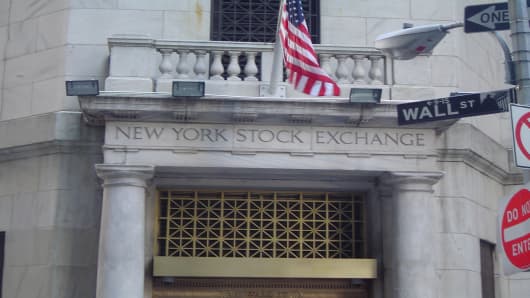
The New York Stock Exchange has set its criteria for trading halts in the event of a steep
market drop, making only slight changes for the first quarter from the fourth, according to data on the NYSE Web site.
![]() |
For the first quarter, circuit breakers will kick in if there is a drop of 1,350 points, or 10 percent, in the Dow Jones industrial average.
There will be a one-hour halt in trading if the drop happens before 2 p.m., a 30-minute halt if the decline occurs between 2 p.m. and 2.30 p.m., and no halt after 2.30 p.m., according to the NYSE.
If the Dow drops 2,700 points or 20 percent, there will be a two-hour halt if it happens before 1 p.m., a one-hour halt if the slide occurs between 1 p.m. and 2 p.m. and the market will
halt for the rest of the day if the slide happens after 2 p.m.
A plunge of 4,000 points or 30 percent -- no matter what time it occurs -- would result in the market being closed for the day. The previous trigger was slightly higher at 4,050 points.
Normal trading hours on the NYSE are 9:30 a.m. to 4 p.m.
The Dow closed the year at 13,264.82, gaining 6.4 percent in 2007.


