

A weakening housing market, a strained banking system, and rising oil prices threaten the U.S. economy, and restoring financial market stability is a top priority, Federal Reserve Chairman Ben Bernanke said on Tuesday.
It was a gloomier assessment than the central bank's policy-setting panel gave in late June, when it said risks to economic growth had diminished somewhat.
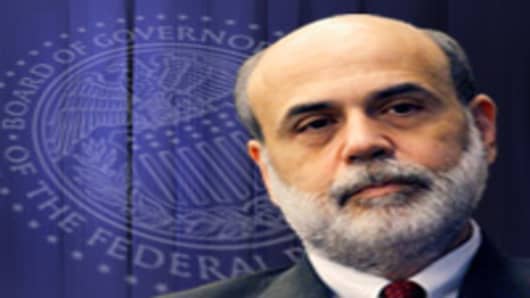
Ben Bernanke
Bernanke, in his semi-annual testimony on economic conditions to lawmakers Tuesday, acknowledged that financial markets had grown increasingly anxious in recent weeks, particularly over the financial condition of mortgage finance companies Fannie Mae and Freddie Mac.
He stressed that the outlook for economic growth and inflation was unusually uncertain.
Investors took that as a signal that the Fed would keep interest rates unchanged at least through August, and perhaps through the end of the year.
"The possibility of higher energy prices, tighter credit conditions, and a still-deeper contraction in housing markets all represent significant downside risks to the outlook for growth. At the same time, upside risks to the inflation outlook have intensified lately," he said.
Bernanke said the slumping housing market was "the most critical and central issue that we face," because it held the key to consumer spending as well as banks' financial health.
"The testimony represents a significant retreat and does imply that the Fed will not be moving to hike (interest) rates anytime soon," said Joseph Brusuelas, chief economist with Merk Investments.
Bernanke's comments come just two days after the Treasury Department, in close coordination with the central bank, tannounced measures to aid Fannie Mae and Freddie Mac, which have been under pressure as the housing market has deteriorated.
In a second hearing before the Senate Banking Committee, Treasury Secretary Henry Paulson said the government-sponsored enterprises "have the potential to pose a systemic risk" to the financial system, and urged Congress to pass legislation creating a stronger regulator.
Paulson, Bernanke and Securities and Exchange Commission Chairman Christopher Cox were testifying at a hastily organized hearing convened to discuss financial issues, including Fannie and Freddie.
Stock prices initially tumbled after Bernanke's comments, but recovered later as oil futures suffered their largest one day price fall in 17 years.
The U.S. dollar remained weak, after seeing a new record low against the euro overnight, while U.S. Treasury bond yields fell.
In its semi-annual monetary policy report to Congress, the Fed raised its projection for growth in 2008 to a range of 1.0 percent to 1.6 percent from the 0.3 percent to 1.2 percent range it forecast in April, on expectations of stronger consumer spending.
President Bush said the economy was still growing, although he acknowledged that there was "obviously financial uncertainty".
With energy costs rising, the Fed also raised its inflation forecast to a range of 3.8 percent to 4.2 percent, up substantially from its previous 3.1 percent to 3.4 percent projection.
Sluggish economic growth and stubborn inflation has made Bernanke's job more difficult as he tries to restrain inflation without tipping the economy into a deep recession.
Pressure has grown, both inside and outside his policy-making committee, for the Fed to consider raising the benchmark federal funds interest rate after cutting it by 3.25 percentage points to 2.0 percent since mid-September.
Shortly before Bernanke testified, government reports underlined the dilemma.
Sales at retail stores barely edged up in June but producer prices, which reflect wholesale inflation, jumped a larger-than-expected 1.8 percent, while the annual rate rose to 9.3 percent, its highest in 27 years.
News from the corporate arena was no more reassuring.
General Motors Corp, struggling with declining vehicle sales, said it will cut 20 percent of its salaried work force, while Kimberly-Clark Corp cut its profit outlook because of high energy costs.
Bernanke said the Fed's efforts to date, including the interst rate cuts and a series of new lending facilities for banks, had had a positive effect but the economy still faced "numerous difficulties." "Many financial markets and institutions remain under considerable stress, in part because the outlook for the economy, and thus for credit quality, remains uncertain," he said.
"Helping the financial markets to return to more normal functioning will continue to be a top priority of the Federal Reserve," he added.