Go Symbol Lookup
Loading...

Nintendo President: 'We Have Scuttled New Hardware'

 Text Size  
Published: Wednesday, 3 Jun 2009 | 10:57 AM ET
By: Chris Morris|Special to CNBC.com
Courtesy Image
Nintendo President Satoru Iwata

In its two-month history, the Nintendo DSi has already sold more than 1 million units. It is, by any definition, a runaway hit in the video game industry. But it wasn’t the company’s first effort at extending its lead in the handheld marketplace.

Nintendo’s global president Satoru Iwata says the company did have another handheld gaming system complete at one point in the past three years, but ultimately decided not to release it.

And it’s not the first time the company has had completed hardware that it ultimately decided to scuttle.

“In the history of Nintendo , there are several such examples," he says. "But when we are launching new hardware, the most important is thing is to sustain the momentum. If introducing new hardware won’t do anything to do that, well…"

Iwata declined to give any details about the recent cancelled product.

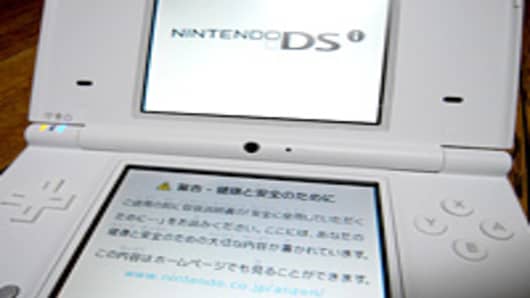
The Nintendo DSi

Fortunately for Nintendo, the company can afford to blow a few R&D dollars these days. The DSi is setting sales records and the Wii is the industry’s top selling console. Wii sales have been falling sharply over the last several months, though, leading the CEO of Gamestop and other industry insiders to express interest in a price cut by Nintendo.

Iwata, though, says that’s not likely to happen soon.

"Right now, we have no plans at all about a price cut," he says. "We are going to start launching the stronger software in the later half of the year — and we are confident [we will] regain the momentum.

"People often talk about the price cut as if it’s an almighty weapon. The fact of the matter is that what a price cut can do is rather limited. … In the long history of video games, at the time of the price cut we see a momentary hike in sales, but usually that can not sustain its momentum and it soon comes down to below the price cut level."

That said, competitor Sony is widely expected to cut the price of the PlayStation 3 this fall. Microsoft likely will not cut prices, but is quite likely to bundle the Xbox 360 with one or more popular games.

Both companies, meanwhile, have also announced plans to incorporate motion-sensing controllers into their consoles, which puts them in even more direct competition with the Wii.

Iwata says Nintendo is watching these, but has known for a long time that its competitors would introduce motion sensors after the Wii proved there was substantial consumer interest in the area.

The Wii controller was a part of Nintendo’s "Blue Ocean" strategy, which boils down to the idea of avoiding a feeding frenzy for a small customer base (aka, a "red ocean") when there’s a much larger, untapped one available (the aforementioned "blue ocean").

A Changing Ocean

The "ocean" is still blue for now, but as Sony and Microsoft begin swimming in the motion control waters, it might change colors fast.

AP
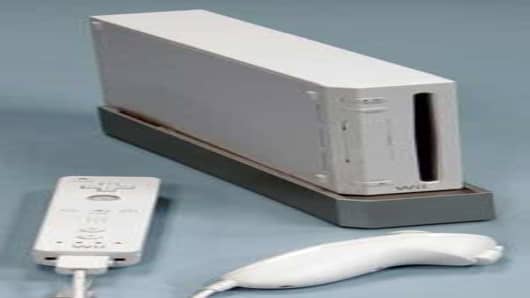
Nintendo Wii

"We have the greater potential to create the blue ocean market when people are skeptical," he says. "So when we realize that other people are coming into [this] market … there are two things we [can] do. One is trying to intensify the fun nature of something we are already doing. The other is try to create a new blue ocean."

Does that hint that the company is planning another major shake-up when it decides to unveil its next generation console down the road? Not necessarily.

Iwata says the company is still investigating whether branching in a new direction or making an iterative step from the Wii is the right move.

Meanwhile, Nintendo is continuing with its strategy to offer new ways to play games. The company on Tuesday coyly announced the Wii Vitality Sensor, a new peripheral that Iwata said could be used to help people better learn to relax in a fun, unique way – much like Wii Fit made exercise appealing for some people.

At its press conference, Nintendo did not offer many details about the Vitality Sensor, other than it would use a fingertip pulse monitor.

In our one-on-one interview, though, Iwata showed a brief video about the product that he had compiled and edited on his flight from Japan to Los Angeles days ago.

The video showed Iwata himself demonstrating the product and revealed a bit more about how the sensor would work. Light pulses will be sent through the user’s finger, tracking their pulse and showing other items, such as their stress level. It also demonstrated some of the possible games/applications for the Vitality Sensor, including one that helped train users how to breath in a more rhythmic fashion, then showed the before and after effects of collecting one’s self.

 Print
In its two-month history, the Nintendo DSi has already sold more than 1 million units. It is, by any definition, a runaway hit in the video game industry. But it wasn’t the company’s first effort at extending its lead in the handheld marketplace.
  Price   Change %Change
GME ---
MSFT ---
6758.T ---
TTWO ---
ATVI ---

   
Comments


More Comments


Add Comments


Your Comments (Up to 1100 characters):

Remaining characters

Your comments have not been posted yet.

Please review your submission to make sure you are comfortable with your entry.

Your Comments:


Featured

Contact Technology

  • Editor of CNBC.com's Tech Section, always plugged in and yet also wireless.

  • Working from Los Angeles, Boorstin is CNBC's media and entertainment reporter and author of CNBC.com's "Media Money" blog.

  • Fortt is CNBC's technology correspondent, working from CNBC's Silicon Valley bureau and contributes to "Tech Check" on CNBC.com.