A lot more bells and whistles are coming to your TV if Sony , Sanyo and Panasonic have anything to say about it: Brighter displays. Internet streaming. 3D. They’re all coming to a living room near you.
The days of plunging prices aren’t over for plasma or LCD TVs, but they won’t continue their freefall for long. iSuppli, a market research and consulting firm specializing in electronics, expects prices for 42-inch and smaller screens to stabilize by 2011 for plasma sets and by 2012 for LCD.
That means profit margins at manufacturers will fall—and fast. And that’s why the hunt is on for the next great thing.
The most imminent contender is the Internet-enabled set. While those sport all the features of a typical HDTV, they also connect directly to the Net, offering a host of applications, including video-on-demand services from Netflix, Blockbuster and Vudu, as well as content from YouTube and Picasa.
The Yankee Group predicts 50 million people will own an Internet-enabled set by 2013, but iSuppli is a bit less optimistic. While manufacturers are pushing the technology, it says, retailers have been less enthusiastic about doing so, which could hurt the adoption rate.
That’s too bad, notes Riddhi Patel, principal analyst for television systems at iSuppli, since an Internet hook could be a big selling point to young consumers.
“They are a connected culture,” she says. “They are not bound by what was the actual broadcast time of the show or when a news item was released. They demand information when they want it. Having an Internet-enabled TV is going to be appealing to those guys.”
The appeal won’t be strong enough to raise prices by the typical 20 percent premium new features command, though. That’s why most companies offering Internet-enabled TVs are focusing on adding the feature to high-end sets, where the margin is already higher.
For most manufacturers, the big future bet is on 3D. With the success of 3D films at the box office, many feel the time is finally right to roll out the technology in the home.
“We believe the next frontier is not resolution—1080p is plenty for most people,” says Bob Perry, executive vice president of Panasonic Consumer Electronics. “The next frontier is making TV more real and more immersive … The only way to do that is stereoscopic 3D.”
Panasonic recently partnered with director James Cameron to promote its HD 3D technology while promoting his upcoming film “Avatar” (which will be shown in 3D). Sony, meanwhile, has hinted that it might enable some of its PlayStation 3 games to take advantage of its 3D HD sets, which are expected to hit store shelves in late 2010.
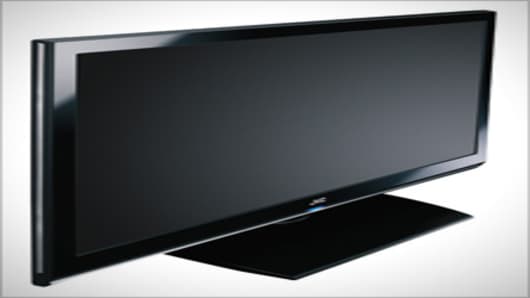
At present, only JVC has a 3D TV on the market, a 46-inch set selling for a whopping $9,153.
It’s not just price that could hurt 3D TVs, though. Analysts question whether consumers will be willing to wear the glasses required to see the effect. And even if they are, how many pairs of glasses will ship with sets? (Manufacturers' cost to make the glasses currently ranges from $50 to $200, says Patel, representing a major hurdle for both margins and consumer acceptance.)
Of course, if new features fail to capture an audience, a brighter, more vivid picture might do the trick. Beyond LCD, there are two new technologies on the rise: LED and OLED.
LED sets—which are actually LCD sets that use LED backlighting—are already on the market. The addition of the LED backlight means a brighter image and deeper blacks, not to mention lower energy consumption. It also means a higher price tag.
OLEDs (Organic Light Emitting Diodes) use a new technology altogether. They boast an even better picture and lower energy consumption, but they’re prohibitively expensive at present, with an 11-inch screen (the largest OLED currently available) selling for up to $2,500.
They’ll eventually make it to market, but Mitchell Kaiser, senior research analyst at Piper Jaffray, says the most optimistic timeframe for widespread availability of OLED sets is the end of 2010, but he expects availability to fall beyond that.
Even then, he adds, it’s not features that ultimately sell HDTVs. It’s price.
“I think you’re going to see an upgrade cycle in the coming years,” he says. “It will really be price-point driven. I think you’ll see the price point come below $2,000 on some of these [new technologies]. Then you’ll see mass adoption.”