

Though the Democratic leadership likes to emphasize the similarities between the House and Senate bills on sweeping financial reform, the upcoming conference to merge the two has the potential to be both fractious and divisive with a number of minefields to cross.
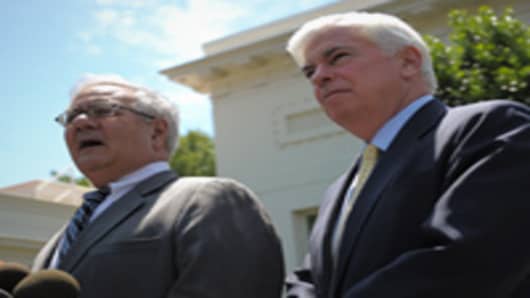
Mandel Ngan | AFP | Getty Images
House Financial Services Committee Chairman Rep Barney Frank and Senate Banking Committee Chairman Senator Chris Dodd.
“They're going to be drowning a lot of puppies,” quips one senior Senate aide
Amendments--tacked on or ignored during earlier rounds—will be disposed of, adding to the existing frustration of Senate members in particular.
“There are too many issues to horse trade on,” says bank analyst Bert Ely. “What’s going to happen is that because the Senate bill was so poorly drafted—there was no committee markup…is that many portions of the bill will be substantially rewritten in resolving the differences.”
Meanwhile, additions will be made, even though the bills already run 1,400-1500 pages.
“It’s inevitable that once you have a certain amount of reform there will be a lot of other things hitched on to it,” says former White House economist and regulator Lawrence White, now a professor at NYU’s Stern School of Business.
Then there’s the role and influence of the White House, because reform is both an important personal issue to President Obama and a chance to reassert some control over the Democratically-controlled Congress.
All the conference members haven’t even been named yet and the event itself is still two weeks, yet both the White House and the conference chairman--House Financial Services Chairman Barney Frank—are already weighing in with their positions on key differences in the two bills. (See a rundown of key differences here)
(The other major Democratic player—Senate Banking Committee Chairman Chris Dodd—seems less interested in showing his cards at this point.)
Republican conference members are also already setting the table. Sen. Bob Corker of Tennessee—who negotiated with Dodd for weeks at the committee level and is a conference member—has already criticized the President for taking a non-partisan approach, while Sen. Judd Gregg has called the bill “a disaster.”
And, if all this weren’t enough, extraneous events and personal circumstances may play a sizable role in the negotiations and their outcome.
Here’s’ some potential minefields.
Derivatives Regulation
One area where personal fortune, politics and policy converge is in derivatives.
The regulation of over-the counter trading, for example, is a contentious issue that divides Democrats and Republicans alike in both chambers.
Thanks to Agriculture Committee Chairwoman Blanche Lincoln of Arkansas, the Senate bill goes beyond the simple regulation of trading by requiring financial firms to create special swaps subsidiaries with their own capital requirements.
Such a tough approach helped Senate Democrats get Maine Republican Olympia Snow to cross party lines and support the bill.
The House version has no such measure, and essentially leaves new supervision to the creation of exchange and clearinghouse systems.
None other than House Financial Services Chairman and conference leader Barney Frank says the provision is unlikely to survive, while the administration continues to make its opposition known. Lincoln, meanwhile, is sticking to her guns.
Analysts—perhaps of the cynical sort—say watering down or even removing the Lincoln provision may partly depend on the results of a primary runoff election June 8, the day before the first meeting of the conference.
If Lincoln losses, then either scenario becomes more likely, say sources. If she wins, then there’s an 800-pound gorilla in the room.
Republicans like Gregg made his ballistic opposition clear on the Senate floor even before Lincoln’s change was added.
He and others are worried about the competitiveness of US firms, even though both the House and Senate bills allow so-called end-user exemptions for firms that want to hedge against their own business risk.
Tricky Amendments
Frank has said that at the least financial firms will be able to hedge for their own business purposes.
“I think they’ll lose Lincoln,“ if her provision does not survive, says ten-term Republican Congress Bill Frenzel, now with the Brookings Institution.
Volcker Rule
Meanwhile, the so-called Volcker rule—whose primary purpose is to limit the proprietary trading of big firms--is in the Senate bill, but not the House one—partly because the White House proposed the idea after the House had approved its bill.
The Volcker rule, however, also includes some restrictions on derivatives contracts, which is promoting some Democrats—including Frank—to see it as a convenient substitute for the Lincoln provision.
“The Goldman [Sachs] brouhaha has changed the political winds,“ says White, referring to the federal government’s civil fraud case against the Wall Street firm.
That may be but the House passed its bill by a relatively narrow margin 223-202, despite its large Democratic majority, and without one Republican vote.
“Every time you put something in you may disaffect as many as you appeal to,” says Frenzel.
Capital Requirements
The converse may also be true. For example, an amendment by Maine Republican Susan Collins added at the last minute of the Senate debate helped win her crossover vote, but sources say its nowhere near as popular as its inclusion implies.
The amendment would essentially tighten capital requirements for banks by excluding a component (Trust Preferred Securities) that qualifies under current criteria, thus forcing banks to raise more capital. Though it affects big bank-holding companies, analysts say the impact on smaller and regional banks would be even greater.
“It’s certainly a big deal, says Mark Calabria of the Cato Institute and a former senior Senate aide.” I think that is reasonable but I think Dodd will cut it.”
That would certainly please some in the Obama administration.
Others say the amendment is well-meaning but poorly crafted.
"I have some sympathy for it," says former FDIC Chairman William Isaac, adding that the lack of a phase-in period is a major problem.
Pro-con aside, however, the Collins amendment illustrates the transitory and perilous nature of of horse-trading in a complicated legislative process.
“If any of these things get winnowed out, you could lose the Republicans,” says Frenzel.
Consumer Agency Exemption
Another Republican on the line may be Sen. Sam Brownback of Kansas, who did not vote for the Senate package but was allowed to have an amendment thrown into the conference mix.
Brownback wants auto dealers exempted from new regulations that would protect consumers from abusive practices in the sale of financial products. An amendment with a similar carve-out provision was added to the House bill thanks to the votes of five Democrats. Dodd, for one, fiercely opposes the idea. The White House is also against it.
Progressive Democrats
For all his artful maneuvering in winning over enough Republican votes to gain passage in the Senate, Dodd did not win friends and influence people within his party.
The progressive wing of the part was both frustrated by its lack of input in the process and bewildered by the banking chairman’s seeming willingness to craft a middle-of-the-road bill in return for strong bipartisan support.
It was no surprise then that neither of the progressives on the banking committee--Jack Reed of Rhode Island and Jeff Merkley of Oregon--was named to the conference panel.
“The troublemakers are not going to be part of it,” predicted one former Senate aide.
That, however, may not prevent them from making their presence known, should their get-tough amendments on financial giants remain out of the bill, as is most likely the case.
One, for instance, would reinstate the Glass-Steagall Act keeping insurers, banks and securities firms out of each other’s business. Another would put a firm limit on the amount of government insured deposits a firm can hold, as a way of capping its size.
“Are a bunch of senators going to Dodd before hand and say we’re not going to vote for the bill,” says one Capitol Hill source. “There's a difference between voting on cloture and a conference report.”
Senators Maria Cantwell of Washington, who submitted two amendments, and Russ Feingold of Wisconsin voted against the Senate bill, which just squeaked by the 60-vote minimum needed to avoid filibuster.
“It makes it very difficult, particularly in the Senate,” says Frenzel. “If you take a united GOP majority and a couple disaffected Democrats, you’re dead.”
