

In “A Christmas Carol,” Ebenezer Scrooge wakes up on Christmas morning, transformed by the night he has experienced, and is thankful to have another chance to be more generous and kind.
Source: Getty Images
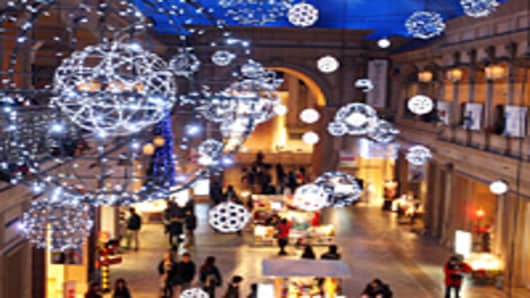
Holiday Mall Decoration
Americans have been through a transformational event of their own: most have seen their retirement accounts decimated by the financial crisis; many have either experienced unemployment first handor through family or friend; others have learned the painful lesson that too much debt—either in a mortgage or on credit cards—can be too hard, if not impossible, to swallow when the economy contracts.
The result is a thriftier consumer, who doesn’t want to throw away money.
So even though retirement account balances have recovered somewhat, and two years of belt-tightening have helped reduce household debt, don’t expect a splurge.
Most forecasts call for holiday, retail sales to be flat or slightly higher than last year.
The industry’s trade organization, the National Retail Federation, is at the higher end, estimating sales will rise 2.3 percent. If this proves correct, retail sales will hit $447.1 billion, and the growth rate only slightly below the average annual increase of 2.45 percent over the 2008-2009 period. Still, even at that level, sales will be below the pre-recession level.
Several factors may tip the scale. On the plus-side: there is a more upbeat mood among affluent consumers, as well as a strong appetite for electronics and higher-quality merchandise. On the downside: there are still uncertainties in the economy, and then there are the changes consumers have gone through.
“I think everything right now is about value and values,” said John Gerzema, president of Young & Rubicam’s Brand Asset Consulting unit and author of “Spend Shift.”
Gerzema expects less mindless spending on gadgets and appliances, and more mindful purchases of higher quality. “The idea is quality over quantity,” he said.
NPD Chief Industry Analyst Marshal Cohen calls it "calculated consumption" and expects consumers' more frugal mindset and deliberate purchases to keep the lid on sales growth. The market research firm expects sales to rise only 0.5 percent to 1.5 percent this holiday season.
"Retailers have already shown they will use price to make consumers buy," Cohen said. He also expects stores lack the truly hot merchandise to get people excited about shopping.
Spending is already weak. In the third quarter, consumer spending rose 2.6 percent, well below other recovery periods. After the 1982 recession, for instance, consumer spending rose between 4 percent and 8 percent during in the months after it ended.
In a BDO study, chief marketing officers for the leading U.S. retailers said stagnant consumer spending and low confidence levels will have the greatest impact on this year’s holiday sales.
The Luxury Wildcard
One area where spending has picked up is luxury, but there may not be enough affluent consumers to move the dial. Still, they are likely to feel more comfortable spending this holiday season since their emotions tend to be closely tied to the stock market, which has been performing better.
The temptation of electronics items also could be a factor. Remember, consumers are looking for value, but what value means is different for everyone. For some, value can mean spending nearly $500 on Apple’s iPad because the product will provide hours of enjoyment. For others, it could mean finally purchasing a flat-screen, plasma television because prices are less than half of what they were a year ago.
For the most part, retailers are focusing their advertising on value and affordability, trying to tempt shoppers with discounts, promotional events and free gifts—and this is just as true at the high-end as at the low.
Walmart is offering free two-way shipping on online sales, and group discounts through its Facebook page.
Kohl’s holiday campaign theme is “Give, save and be merry”, while JCPenney’s advertising focuses on big sales and early doorbusters.
Target is offering cardholders 5 percent back on credit-card purchases, 50-percent off on daily deals, including promotional events—hyped with catchy names like “Total Toy Tuesdays” and “Mega Merry Mondays.”
Even upscale stores are trumpeting deals: Nordstrom has free shipping and Neiman Marcus is tempting shoppers with a “Buy Now, Gift Later” promotion that promises free shipping and gift wrap.
Such messages are resonating. Shoppers are planning hit the stores with a set budget and well-laid plans. They’re using tools like Facebook, Twitter and their smartphones to research deals, while retailers are using every trick they can to lurethem into the store as early in the season as possible.
Huge Black Friday Turnout Expected
A study by America’s Research Group and UBS predictsthe largest turnout of shoppers for Black Friday in its 20-year history of Christmas spending research. About 48.9 percent of Americans plan to shop the day after Thanksgiving. Of those, 65.0 percent want the deepest discounts—the early-bird specials.
Getty Images
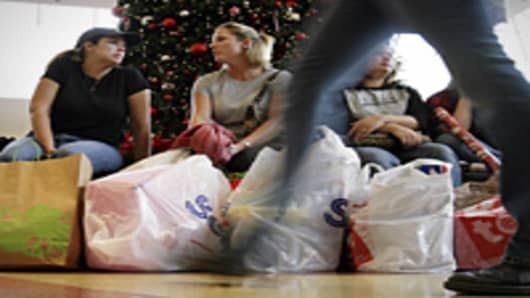
Shoppers take a break at the Baybrook Mall in Friendswood, Texas.
But that may not herald a strong season. The survey found three out of five people, or some 59.2 percent of Americans, expect to spend less this year, and Black Friday bargains can help stretch those budgets farther.
One reason may be that Americans are pledging to cut back on credit card use; more than seven in ten people surveyed said they were experiencing some to a lot of credit or debt pressure.
Last year, nearly two out of every five people used credit cards to pay for Christmas gifts. This year, only 15.8 percent plan to use credit cards, according to the study.
One for You, One for Me
While that is discouraging, there is another more positive trend to watch. Multiple holiday surveys have noted an increased willingness to splurge on oneself.
The American Express Spending & Savings Tracker found 43 percent of shoppers would buy something for themselves. Among young professionals the number was even higher, with 63 percent saying so.
Consumers are increasingly willing to indulge their “wants” over their “needs.” In a Big Research survey, 54.1 percent said they are focused on necessities. While still high, it’s three percentage points lower than in October and a point lower than a year ago.
But other surveys have contradicted that finding. The ARG/UBS survey found those buying something nice for themselves at an all-time low of 28.6 percent. (Compare that to the 49.4 percent of 2002.)
Such conflicting signals are setting up this season to be a nail biter—right to the bitter end, as many consumers are expecting to hold out in the hope of steeper discounts closer to the holiday.
Who Wins, Who Loses?
Dollar stores and discounters will remain popular places for bargains and for those strapped for cash. Meanwhile, high-end retailers will likely benefit from increased spending on luxury goods.
But what happens to those in the middle? They’ll have to draw on the loyalty of their customers and look for creative promotions.
Gerzema expects companies expressing the right values will succeed. Brands like ETSY, which offers “handmade” Christmas gifts, strike the right chord with consumers who want to be more self-reliant.
Others such as Zappos.comwill be hailed for their customer service, while brands like FootLocker will suffer, Gerzema said. He also expects premium brands, like Burberry and Theory, to triumph over mass-market mainstays, such as Gap’s Old Navy.
Electronics also are expected to be hot this year. A survey by the Consumer Electronics Association found that consumers will spend an average of $232 on gadgets and gizmos. That’s a five-percent improvement over 2009—and the highest ever in its 17 years of tracking spending habits.
